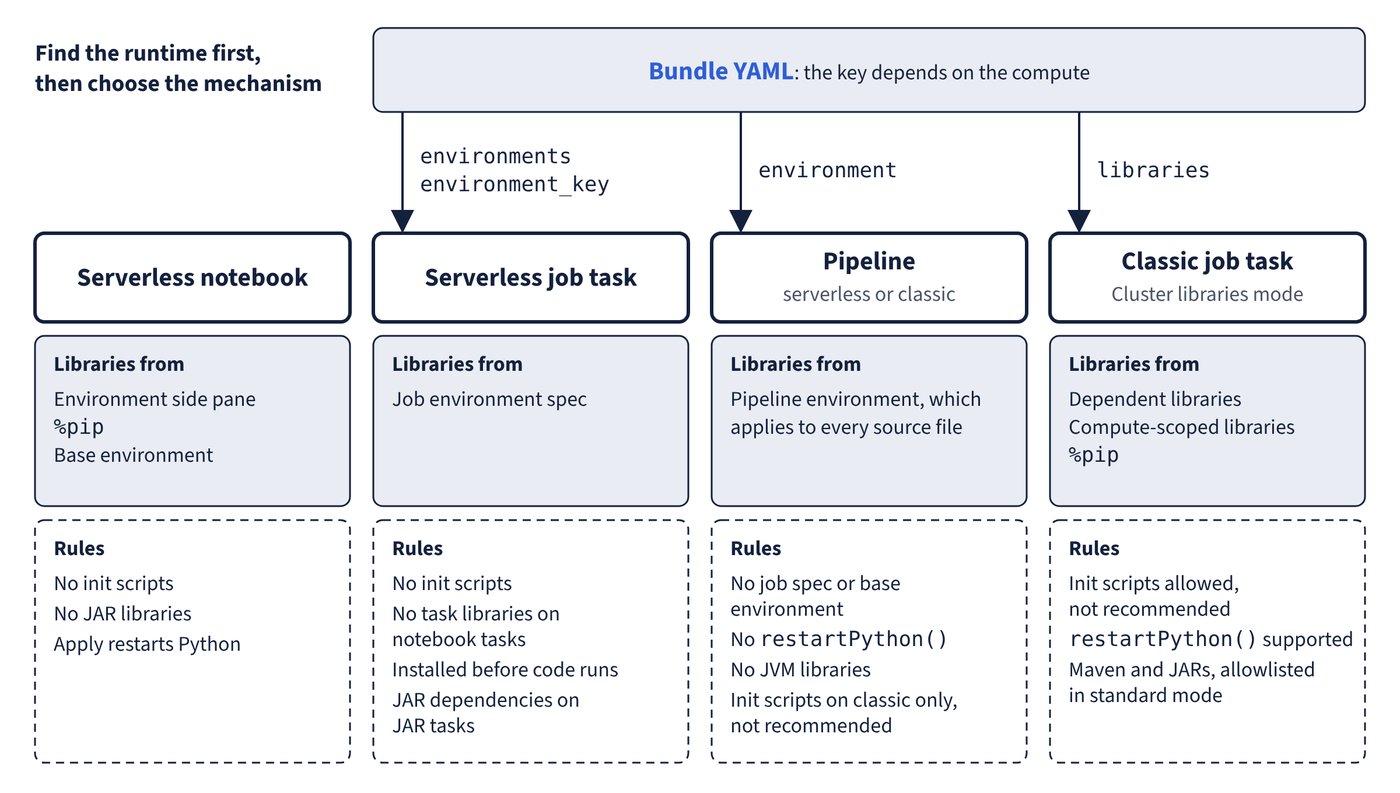
This table is the core of the chapter. Find the runtime first, and only then choose the mechanism, because several of them work in only one place. Figure 2.1 shows the main routes, including the key a bundle uses for each.
| Environment | Declare libraries in | Init scripts | Python restart | JVM libraries |
|---|---|---|---|---|
| Serverless notebook | Environment side pane, %pip, base environment |
No | Apply restarts Python | No JAR libraries in notebooks |
| Serverless job task | Job environment spec (environments, environment_key) |
No | Installed before code runs | JAR dependencies on JAR tasks |
| Serverless pipeline | Pipeline environment |
No | restartPython() not supported |
Not supported |
| Classic pipeline | Pipeline environment |
Yes, not recommended | restartPython() not supported |
Not supported, even by init script |
| Classic, Cluster libraries mode | Compute-scoped libraries, Dependent libraries, %pip |
Yes, not recommended | restartPython() supported |
Maven and JARs, allowlisted in standard mode |
| Classic, Environments mode (Beta) | Base environment, job environment spec | No | Apply restarts Python | Spark JAR tasks not supported |
Job and task settings in bundles
A bundle has two distinct places to declare a job task’s Python dependencies, and which applies depends on the compute.
```yaml