Vector search finds content by meaning rather than exact words, and hybrid search combines it with keyword search. Both depend on how vector fields, algorithms and vectorizers are configured in the index.
Vector fields and the vectorSearch section
- Vector field:
Collection(Edm.Single)withdimensionsequal to the embedding model’s output (1,536 for text-embedding-ada-002), plusvectorSearchProfile. It must besearchable. It can’t be filterable, facetable or sortable, and can’t have analyzers or synonym maps. vectorSearchsection:algorithms(hnsworexhaustiveKnn),vectorizers,compressions(scalarint8or binary quantisation) andprofiles. A profile bundles an algorithm, a vectorizer and compression, and each field uses one profile.- HNSW defaults are
m4 (range 4–10),efConstruction400 andefSearch500 (each 100–1,000). Use metriccosinewith Azure OpenAI embeddings.
| HNSW | Exhaustive KNN | |
|---|---|---|
| Result | Approximate nearest neighbours | Exact, brute force over all vectors |
| Memory | Graph held in memory, uses vector index quota | No vector index quota |
| Suits | Most workloads, large data | Small or medium data, precision first, ground truth for recall testing |
| Switch | "exhaustive": true per query on an HNSW field |
Can’t run HNSW queries |
Common trap: indexing a field with
exhaustiveKnnand planning to query it with HNSW later - only HNSW fields can switch per query, and only to exhaustive.
Vector queries
vectorQueriestakeskind: "vector"(a raw array) orkind: "text".kind: "text"needs a vectorizer on the field that uses the same embedding model as indexing; this is integrated vectorisation at query time.- Other properties:
fields(up to 10),k, andweight(default 1.0).
Hybrid queries
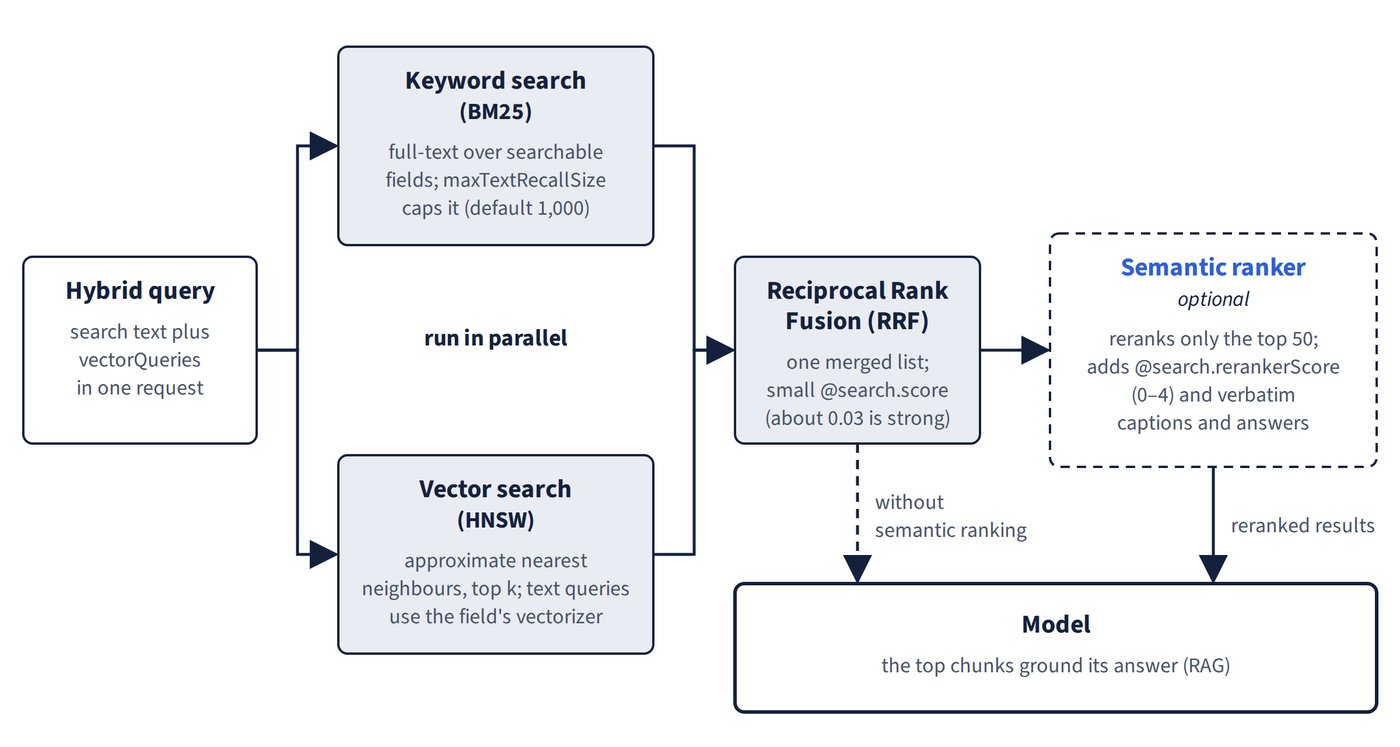
- Hybrid search sends
searchtext plusvectorQueriesin one request. The two run in parallel and merge with Reciprocal Rank Fusion (RRF). Figure 12.2 follows a hybrid query from the request to the model. - RRF
@search.scorevalues are small (about 0.03 can be a strong match). hybridSearch.maxTextRecallSize(preview) caps the BM25 side, with a default of 1,000 and a maximum of 10,000.