Comparing training runs is only possible if every run records its parameters, metrics and model in a consistent way. In Azure Machine Learning that tracking layer is MLflow.
- MLflow is Azure ML’s tracking API; SDK v2 has no logging API of its own. The workspace is an MLflow-compatible tracking server:
- Inside Azure ML jobs, the tracking URI is set automatically.
- When training elsewhere, set it with
mlflow.set_tracking_uri.
mlflow.set_experiment("<name>")sets the active experiment. Insidemlflow.start_run(),mlflow.log_param,mlflow.log_metricormlflow.autologrecord parameters and metrics on each run, so runs can be compared in experiment history.mlflow.sklearn.log_model(model, "model")stores the model under the artifact path"model". The artifact path is exactly the string you pass. Figure 3.1 shows how workspace, experiment, runs and the registered model fit together.
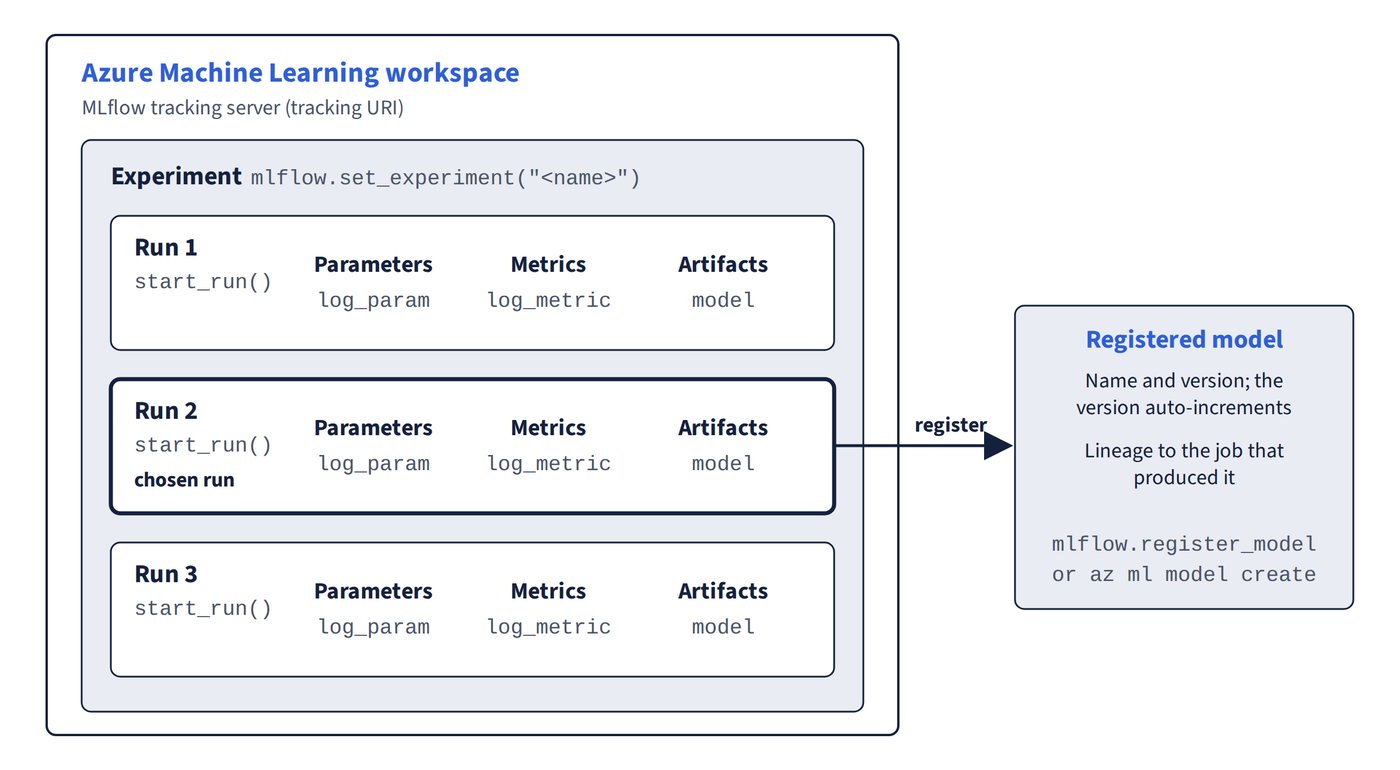
Common trap: Assuming the experiment name defines the model’s artifact path - the path is the literal string passed to
log_model.
- Other monitoring services don’t replace experiment tracking. Job output logs are unstructured text. Application Insights and Azure Monitor alerts cover deployed apps and resources. An Azure Monitor workspace holds Prometheus metrics. None of these records comparable runs.