The five Cosmos DB consistency levels, what each guarantees, and the latency and availability trade-offs.
From Ultra Transcenders AZ-305 by Tony Rough (publishing soon)
Consistency is a trade-off between how fresh a read is and how fast and available writes are. Cosmos DB offers five levels, and the choice affects which service level agreements apply.
Figure 7.1 lays the five levels out on a single spectrum and shows where the SLA and multi-write-region limits fall.
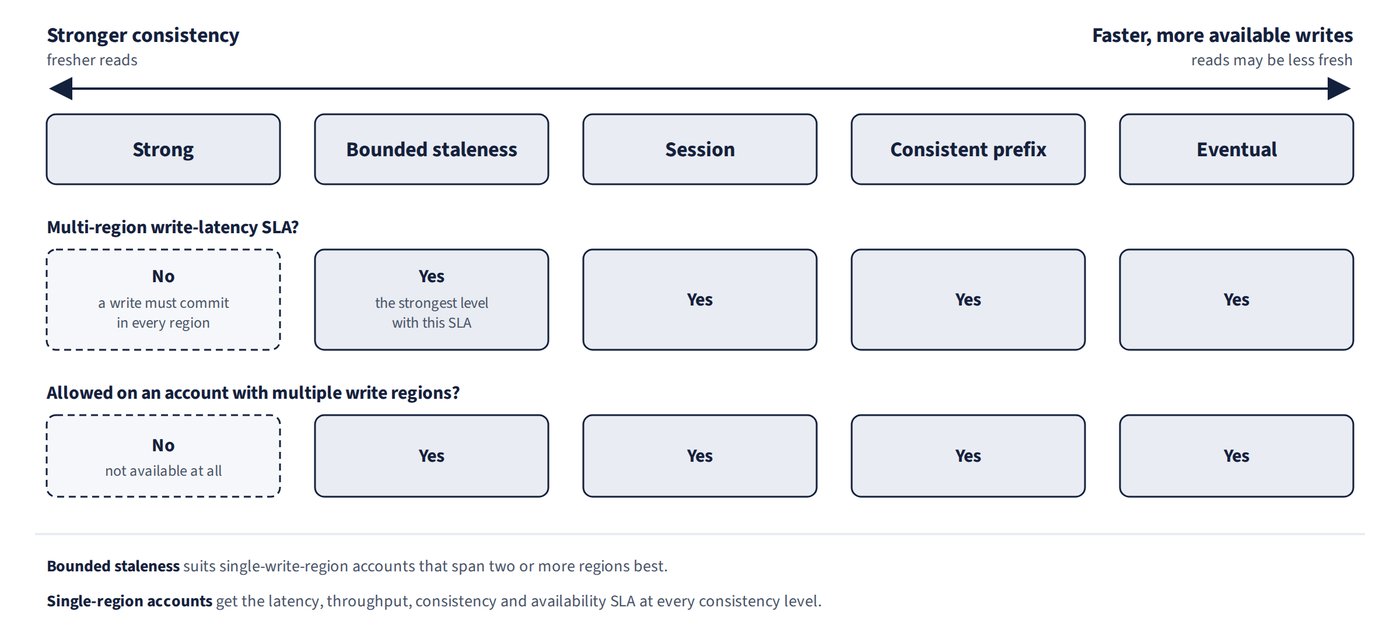
| Consistency (strongest first) | Write-latency SLA on multi-region accounts? |
|---|---|
| Strong | No (a write must commit in every region) |
| Bounded staleness | Yes (the strongest level with this SLA) |
| Session, Consistent prefix, Eventual | Yes |
This note is one section of Ultra Transcenders AZ-305: Designing Microsoft Azure Infrastructure Solutions, an independent study guide that explains every topic the exam covers by technology, with comparison tables, diagrams and the common traps, plus a glossary linked to Microsoft Learn.
Publishing soon on Amazon in Kindle and paperback editions.
About the book · Free AZ-305 glossary · All AZ-305 study notes
Choosing a redundancy option for durability and availability targets, and what customer-managed account failover does.
How to pick between Azure SQL Database, Azure SQL Managed Instance and SQL Server on Azure VMs from compatibility and management requirements.
Zone redundancy, active geo-replication and failover groups for Azure SQL, with the RPO and RTO each design gives.
A decision guide to Azure compute services by control, scale and operational effort.
How private endpoints and service endpoints differ, and how to design private DNS for hybrid networks.
Choosing between Azure's global and regional, layer 4 and layer 7 load-balancing services.
System-assigned vs user-assigned managed identities, workload identity federation and when to use each.