Redundancy decides how many copies of your data exist and how large a failure they can survive, from a single rack up to a whole region. Choose the cheapest option that meets the failure scenario you must tolerate, and remember that only the geo-redundant options support account failover.
Figure 5.1 shows where the copies live under each option.
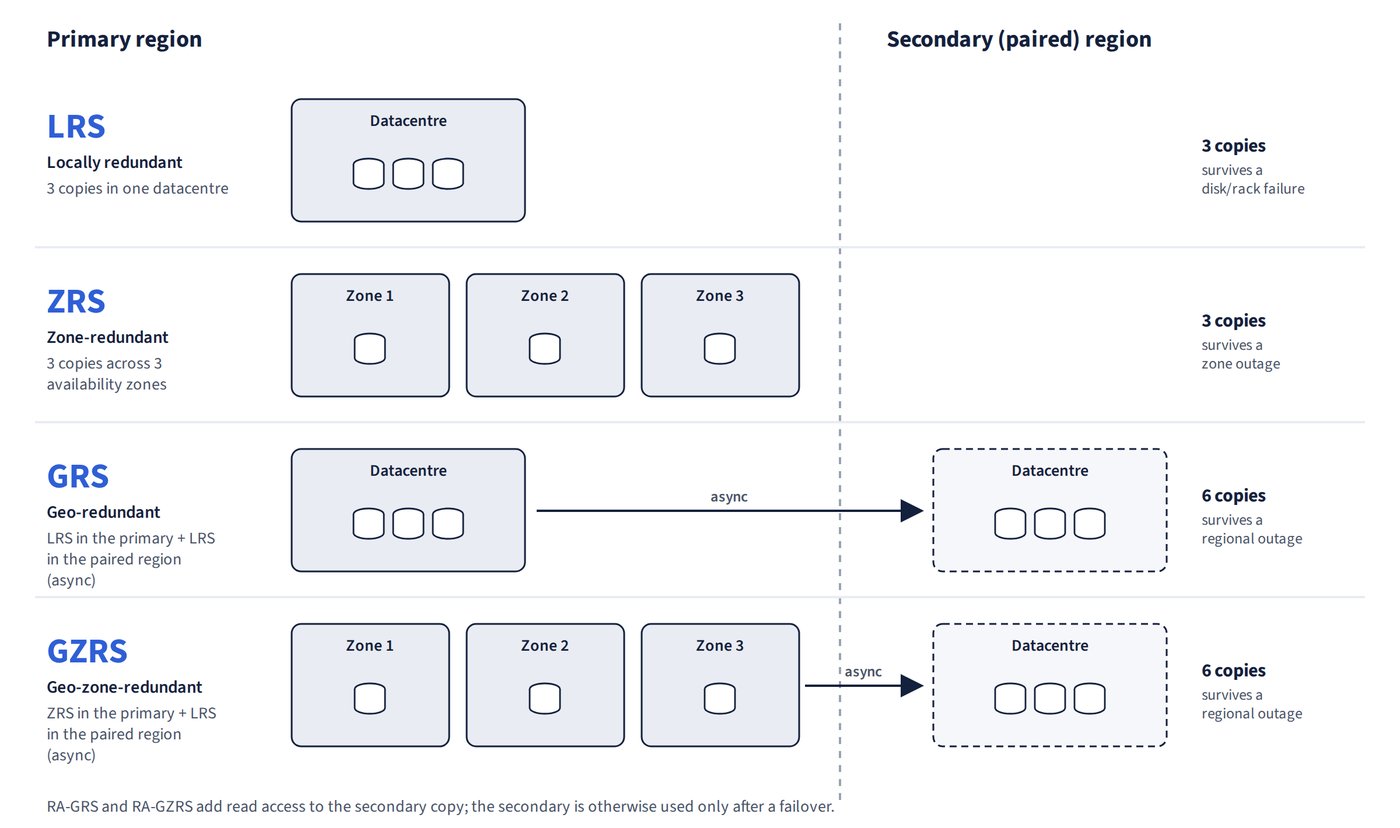
| Option | Copies | Survives | Secondary readable |
|---|---|---|---|
| LRS | 3 in one datacentre | Disk/rack failure | – |
| ZRS | 3 across availability zones, one region | Datacentre (zone) failure | – |
| GRS | 6: LRS primary + LRS in paired region | Regional outage | Only after failover |
| RA-GRS | As GRS | Regional outage | Yes, read-only secondary endpoint |
| GZRS / RA-GZRS | ZRS primary + LRS secondary | Zone and region | RA- only |
Choosing a redundancy option
- Premium accounts (premium block blob and premium file shares) support only LRS and ZRS; geo-redundancy needs a standard account. So the most resilient configuration for WORM data is Standard GPv2 + RA-GZRS (RA-GRS where GZRS isn’t available).
- Reads from a paired region: if a second instance of an application runs in the paired region (for example, East US and West US), use RA-GRS. Writes go once to the primary, and the second instance reads from the secondary endpoint.
- Plain GRS is the right choice when you don’t need secondary reads, because it is cheaper than RA-GRS.
- Writes to all geo-redundant storage (GRS, GZRS) happen in the primary region only.
Account failover
- Customer-managed account failover requires GRS, RA-GRS, GZRS or RA-GZRS. The secondary becomes the primary and DNS records are updated, so your connection strings stay the same.
- After an unplanned failover the account is LRS in the new primary region. Reconfigure GRS so that data replicates back and you can fail back. A planned failover keeps geo-redundancy.
Common trap: Configuring ZRS before a failover — ZRS keeps all copies in one region and has no secondary, so there is nothing to fail over to. Failover needs GRS, RA-GRS, GZRS or RA-GZRS.