Expectations are optional clauses on streaming tables, materialized views and temporary views that test every record against a SQL Boolean constraint and record the results. They need the ADVANCED product edition.
Each expectation has three parts: a name (unique within the dataset, used in metrics), a constraint (valid SQL that returns true or false per record) and an action. Figure 8.1 compares the three actions.
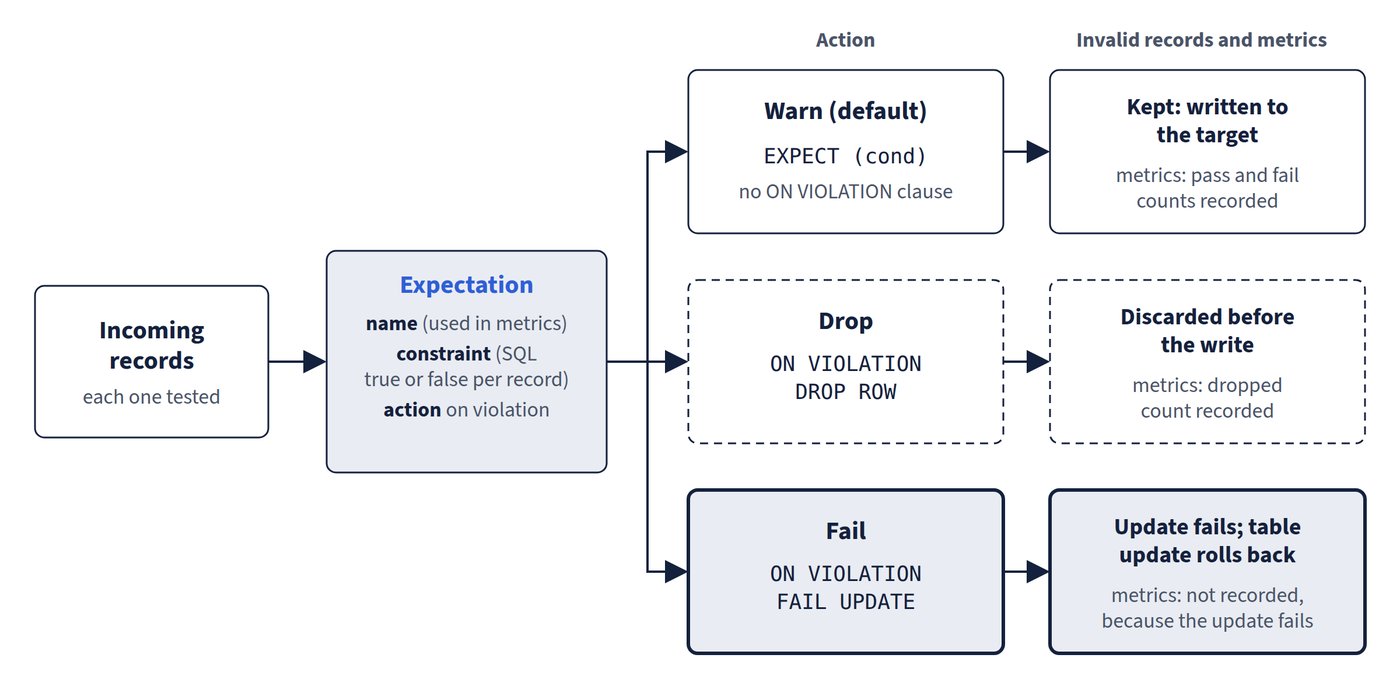
| Action | SQL | Python | Effect on invalid records | Metrics |
|---|---|---|---|---|
| warn (default) | CONSTRAINT n EXPECT (cond) |
@dp.expect("n", "cond") |
Written to the target | Pass and fail counts recorded |
| drop | ... EXPECT (cond) ON VIOLATION DROP ROW |
@dp.expect_or_drop("n", "cond") |
Dropped before the write | Dropped count recorded |
| fail | ... EXPECT (cond) ON VIOLATION FAIL UPDATE |
@dp.expect_or_fail("n", "cond") |
The flow’s update fails and the table update rolls back | Not recorded, because the update fails |
CREATE OR REFRESH STREAMING TABLE orders_silver(
  CONSTRAINT valid_id     EXPECT (order_id IS NOT NULL) ON VIOLATION DROP ROW,
  CONSTRAINT valid_amount EXPECT (amount >= 0) ON VIOLATION FAIL UPDATE,
  CONSTRAINT recent       EXPECT (order_date >= '2020-01-01')
) AS SELECT * FROM STREAM(orders_bronze);
Grouped expectations in Python
Only Python can group expectations with a collective action. expect_all, expect_all_or_drop and expect_all_or_fail each take one dictionary of name-to-constraint pairs; the single forms take a description and a constraint as two strings. Each expectation in the dictionary still reports its own metrics, and the same dictionary can be reused across datasets or loaded from a rules table.
from pyspark import pipelines as dp

valid_orders = {"valid_id": "order_id IS NOT NULL", "valid_qty": "quantity > 0"}

@dp.table
@dp.expect_all_or_drop(valid_orders)
def orders_clean():
    return spark.readStream.table("orders_bronze")
What fail does in each pipeline mode
In a triggered pipeline, a failed expectation fails and rolls back only that flow; other parallel flows keep updating. In a continuous pipeline, the failure stops the flow and all dependent flows, and the pipeline reports why. Either way, someone must fix the code or data before reprocessing; the error message (EXPECTATION_VIOLATION) shows the violated expectation and, for many queries, the offending input record.
Limits to know
- Constraints can’t contain custom Python functions, external service calls or subqueries that reference other tables.
- Metrics exist only for streaming tables, materialized views and temporary views, and not for flows such as sinks that don’t support expectations. Views can show no metrics, or several sets if several datasets query them.
- Expectations aren’t supported with
AUTO CDC FROM SNAPSHOT. - Expectations enforce data quality, not orchestration: a failed check doesn’t skip downstream datasets in the same pipeline.
Common trap: Passing several description and constraint strings to
@dp.expect_all_or_drop- theexpect_alldecorators take a single dict of{name: constraint}; the two-argument form belongs toexpect,expect_or_dropandexpect_or_fail.
Common trap: Assuming a failed expectation in one flow always leaves the rest of the pipeline running - that holds for triggered pipelines only; in a continuous pipeline it also stops every dependent flow.