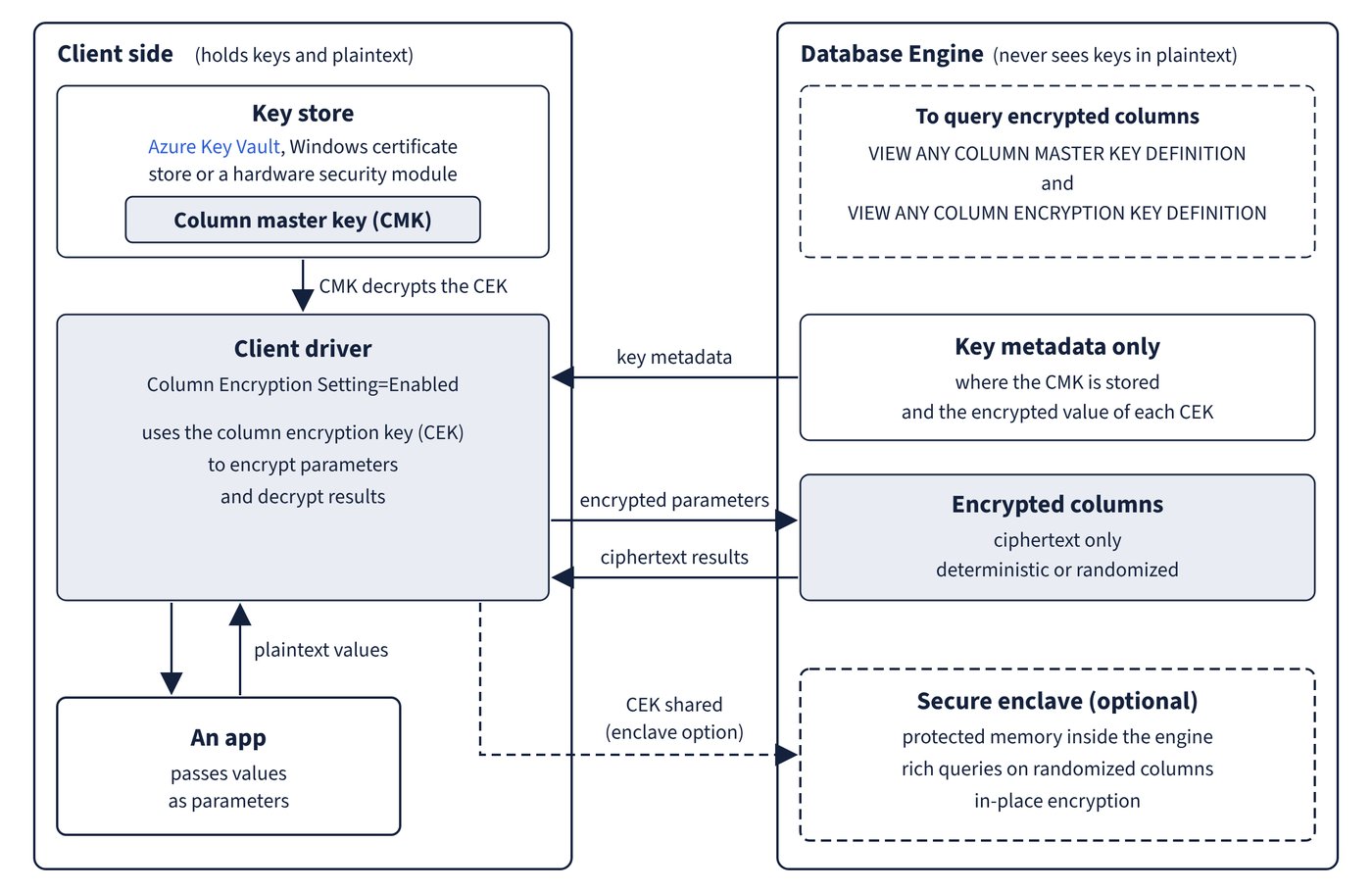
Always Encrypted encrypts selected columns inside the client driver, so plaintext data and keys never appear in the Database Engine. It separates data owners from data managers such as on-premises DBAs and cloud operators. It’s available in SQL Server, Azure SQL Database and Azure SQL Managed Instance; it isn’t available in SQL database in Fabric. Figure 7.1 shows where the keys live and what each side sees.
Keys and key stores
Always Encrypted uses two kinds of keys:
- A column encryption key (CEK) encrypts the data in one or more columns.
- A column master key (CMK) is a key-protecting key that encrypts CEKs. It’s stored outside the database, in Azure Key Vault, the Windows certificate store or a hardware security module.
The database stores only metadata: the CMK’s location and the encrypted value of each CEK. Because the engine must never see keys in plaintext, T-SQL can’t provision keys or encrypt existing data; SSMS, PowerShell or SqlPackage do it outside the database. Four database permissions govern the feature.
| Permission | Needed for |
|---|---|
ALTER ANY COLUMN MASTER KEY |
Creating and dropping CMK metadata |
ALTER ANY COLUMN ENCRYPTION KEY |
Creating and dropping CEK metadata |
VIEW ANY COLUMN MASTER KEY DEFINITION |
Querying encrypted columns |
VIEW ANY COLUMN ENCRYPTION KEY DEFINITION |
Querying encrypted columns |
In SQL Server the public role holds the two VIEW ANY permissions by default; in Azure SQL Database it doesn’t, so they must be granted explicitly before users can work with encrypted columns.
Deterministic versus randomized encryption
Both types use the AEAD_AES_256_CBC_HMAC_SHA_256 algorithm; the choice is about what queries remain possible.
| Aspect | Deterministic | Randomized |
|---|---|---|
| Same plaintext gives same ciphertext | Yes | No |
| Operations without enclaves | Equality (=), IN, GROUP BY, DISTINCT, equality joins, indexing |
None |
| Leaks patterns | Yes, especially with few distinct values (True/False, regions) | No |
| Character column collation | Must be a _BIN2 collation |
_BIN2 required for Always Encrypted columns generally |
| Typical use without enclaves | Values searched or joined, such as a national ID | Values never searched, such as a card number found by another key |
| Recommended with secure enclaves | No | Yes |
Joining two deterministically encrypted columns needs both to use the same CEK. The documented operand clash error (Msg 206) appears when a query compares an encrypted column with a literal or a plaintext column, or copies data between encrypted and plaintext columns with INSERT...SELECT, SELECT INTO, UPDATE or BULK INSERT. Applications must pass values as parameters; in SSMS, turn on Parameterization for Always Encrypted.
CREATE TABLE dbo.Patients (
    PatientId int IDENTITY PRIMARY KEY,
    NationalId char(11) COLLATE Latin1_General_BIN2
        ENCRYPTED WITH (COLUMN_ENCRYPTION_KEY = CEK1,
                        ENCRYPTION_TYPE = DETERMINISTIC,
                        ALGORITHM = 'AEAD_AES_256_CBC_HMAC_SHA_256') NOT NULL,
    BirthDate date
        ENCRYPTED WITH (COLUMN_ENCRYPTION_KEY = CEK1,
                        ENCRYPTION_TYPE = RANDOMIZED,
                        ALGORITHM = 'AEAD_AES_256_CBC_HMAC_SHA_256') NOT NULL
);
NationalId supports point lookups and an index; BirthDate can only be stored and returned. The client turns the feature on with Column Encryption Setting=Enabled in a Microsoft.Data.SqlClient connection string (ODBC uses ColumnEncryption=Enabled), and needs access to the CMK in its key store; the Azure Key Vault provider for .NET ships as a separate NuGet package.
Limitations to design around
Always Encrypted can’t be applied to columns that are xml, rowversion, sql_variant, hierarchyid, spatial or vector types; that have IDENTITY or a DEFAULT constraint; that are referenced by CHECK constraints, used as partitioning columns, included in full-text indexes, masked with DDM, or captured by change data capture. Queries using FOR JSON or FOR XML aren’t supported, nor are table-valued parameters targeting encrypted columns. Randomized columns can’t be primary keys, index keys or unique-constraint columns. Transactional, merge and snapshot replication don’t work on encrypted columns, although availability groups do. After changing an encrypted column, run sp_refresh_parameter_encryption for dependent modules.
Always Encrypted with secure enclaves
A secure enclave is a protected memory region inside the engine process where the driver can share CEKs so the server can compute on plaintext. It adds rich confidential queries and in-place encryption: encrypting, re-encrypting (key rotation or type change) and decrypting a column with ALTER TABLE ... ALTER COLUMN without moving data to the client.
| Operation on enclave-enabled randomized columns | Azure SQL Database | SQL Server 2022 and later | SQL Server 2019 |
|---|---|---|---|
Comparison operators, BETWEEN, IN, LIKE, DISTINCT |
Supported | Supported | Supported |
| Joins | Supported | Supported | Nested loop joins only |
ORDER BY, GROUP BY |
Supported | Supported | Not supported |
Key facts:
- Rich operations need randomized encryption with an enclave-enabled CEK (a CEK protected by a CMK with
ENCLAVE_COMPUTATIONS); deterministic columns still allow only equality. - The database compatibility level should be 160 or higher.
- Platforms: SQL Server 2019 and later on Windows (VBS enclaves) and Azure SQL Database (VBS enclaves, or Intel SGX on DC-series hardware). Azure SQL Managed Instance isn’t listed.
- Intel SGX enclaves reach end of support on 31 October 2027; databases still on DC-series are then moved to standard-series hardware with VBS enclaves.
- Attestation: Microsoft Azure Attestation is mandatory for SGX; VBS enclaves in Azure SQL Database don’t support attestation; SQL Server VBS enclaves use Host Guardian Service or no attestation.
- Enable accelerated database recovery before creating the first index on an enclave-enabled randomized column (it’s on by default in Azure SQL).
- Only Windows Certificate Store and Azure Key Vault can hold enclave-enabled CMKs.
Common trap: Expecting range or
LIKEqueries on a deterministically encrypted column once enclaves are enabled - enclave computations require randomized encryption; deterministic columns remain limited to equality.
Common trap: Planning Always Encrypted for SQL database in Microsoft Fabric - the Fabric limitations page lists Always Encrypted as not supported and says Always Encrypted tables can’t be created there; use cell-level encryption or keep the data in Azure SQL Database.