The three technologies answer different questions: how much data can be lost (RPO), how fast service must return (RTO) and how far back recovery must reach. Figure 9.1 places the three technologies by RPO and RTO and shows what each keeps.
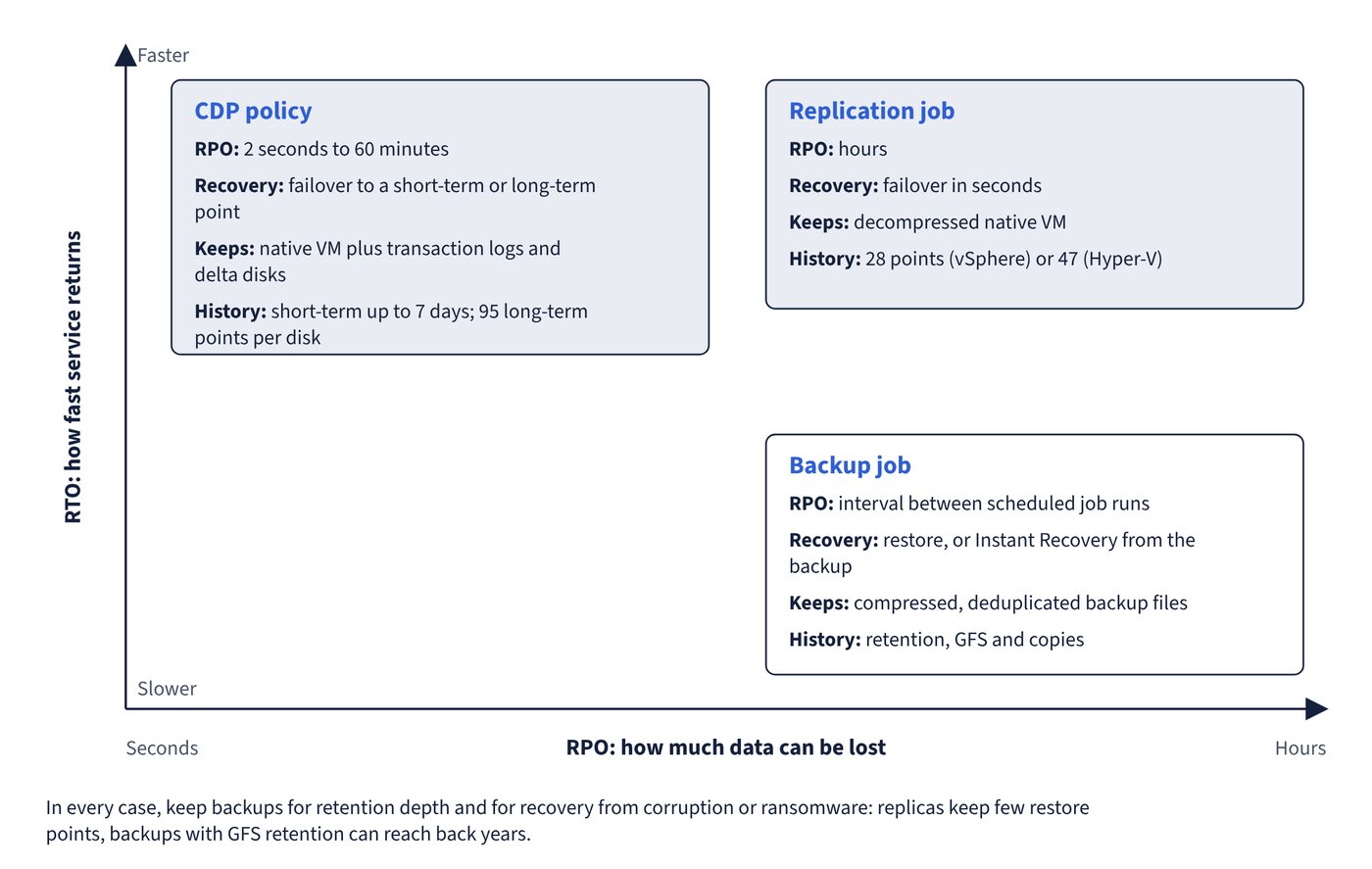
| Characteristic | Backup job | Replication job | CDP policy |
|---|---|---|---|
| Capture method | Snapshot, written to backup files | Snapshot, written to a VM copy | I/O filter, no snapshots |
| RPO guidance | Interval between scheduled job runs | Hours | 2 seconds to 60 minutes |
| Storage format | Compressed, deduplicated backup files | Decompressed native VM | Native VM plus transaction logs and delta disks |
| Recovery | Restore, or Instant Recovery from the backup | Failover in seconds | Failover to a short-term or long-term point |
| Depth of history | Retention, GFS and copies | 28 points (vSphere) or 47 (Hyper-V) | Short-term up to 7 days; 95 long-term points per disk |
| Platforms | All supported workloads | vSphere, Hyper-V; Proxmox VE VM replication added in 13.1 | vSphere VMs; Universal CDP for Windows and Linux machines |
| Automated verification | SureBackup | SureReplica (vSphere) | SureReplica (vSphere) |
Decision rules:
- A service that must restart in the DR site within seconds, with hours of data loss acceptable: replication job (replica from backup avoids a second production snapshot).
- A vSphere VM where minutes of data loss are unacceptable: CDP policy, after checking vCenter, host RAM, I/O filter and network requirements (at least 100 Mbps; 10 Gbps with MTU 9000 performs best).
- A physical or cloud machine needing near-zero RPO: Universal CDP to vSphere.
- In every case, keep backups for retention depth and recovery from corruption or ransomware (see Chapter 8: Backup copy, long-term retention and the 3-2-1 rule and Chapter 7: Repositories: hardened, immutable, object storage and scale-out).
Common trap: Using a replica as the long-term history of a VM - a vSphere replica keeps at most 28 restore points and a CDP replica at most 95 long-term points per disk, while backups with GFS retention can reach back years.