An independent study guide for VMware Certified Professional – VMware Cloud Foundation Architect · by Tony Rough
Know which VCF design decision meets the requirement, and why.
Free to read with Kindle Unlimited. Opens Amazon in a new tab.
Free glossary of the book's terms
First edition · published October 2026
This independent study guide for the VMware Certified Professional – VMware Cloud Foundation Architect (VCP-VCF Architect) exam turns what 2V0-13.25 expects you to understand into the comparisons, decisions and traps that real VCF design work depends on. The exam is based on VMware Cloud Foundation 9.0, and the book is too, written from Broadcom's own 9.0 design guidance: the architectural options, the design library and the design blueprints.
Fifteen chapters, each one readable on its own, that together cover every exam objective:
There are no exam questions in this book. It explains the knowledge the exam looks for, so you can reason through scenarios you have never seen and bring the same judgement to a real VMware Cloud Foundation design.
Written by Tony Rough, a cloud architect with over twenty years in IT infrastructure, whose VMware certifications include the VCAP-DCD in data centre design, the discipline this exam tests.
Part of the Ultra Transcenders series from Distilled Press. An independent publication, not affiliated with, sponsored by or endorsed by Broadcom Inc. VMware, VMware Cloud Foundation, vSphere, vSAN, NSX and HCX are trademarks of Broadcom Inc. and/or its subsidiaries.
Every skill area in Broadcom's 2V0-13.25 outline (as of November 2026), and the chapters that cover it.
| Skill area | Weight | Chapters |
|---|---|---|
| Objective 1.1 Differentiate between business and technical requirements | — | 1 |
| Objective 1.2 Differentiate between a Conceptual Model, logical design and physical design | — | 1 |
| Objective 1.3 Differentiate between requirements, assumptions, constraints and risks | — | 1 |
| Objective 1.4 Differentiate between availability, manageability, performance, recoverability and security (AMPRS) | — | 2 |
| Objective 1.5 Develop and document a risk mitigation strategy | — | 2 |
| Objective 1.6 Document design decisions | — | 2 |
| Objective 1.7 Develop a design validation strategy | — | 2 |
| Objective 2.1 VMware Cloud Foundation architecture options | — | 3 |
| Objective 3.1 Gather and analyze business objectives and requirements | — | 1 |
| Objective 3.2 Given a set of business objectives, create a conceptual model | — | 1 |
| Objective 3.3 Create VMware Cloud Foundation (VCF) logical designs | — | 3, 4, 5, 6, 7, 14, 15 |
| Objective 3.4 Create VMware Cloud Foundation (VCF) physical designs | — | 3, 4, 5, 6, 7, 14, 15 |
| Objective 3.5 Design for Availability | — | 8 |
| Objective 3.6 Design for Manageability | — | 9 |
| Objective 3.7 Design for Performance | — | 10 |
| Objective 3.8 Design for Recoverability | — | 8, 11 |
| Objective 3.9 Design for Security | — | 12 |
| Objective 3.10 Design a Workload Migration / Onboarding strategy | — | 13 |
| Objective 3.11 Design a consumption strategy for VMware Cloud Foundation (VCF) | — | 14 |
| Objective 3.12 Design a monitoring strategy for VMware Cloud Foundation (VCF) | — | 15 |
Plus an appendix glossary of 400+ terms, each linked to Broadcom TechDocs, with the same terms explained free online for print readers.
Short excerpts from the book, exactly as they appear in it, so you can see how it explains things.
The opening of chapter 1 · Chapter 1: The design method: requirements, conceptual, logical and physical design
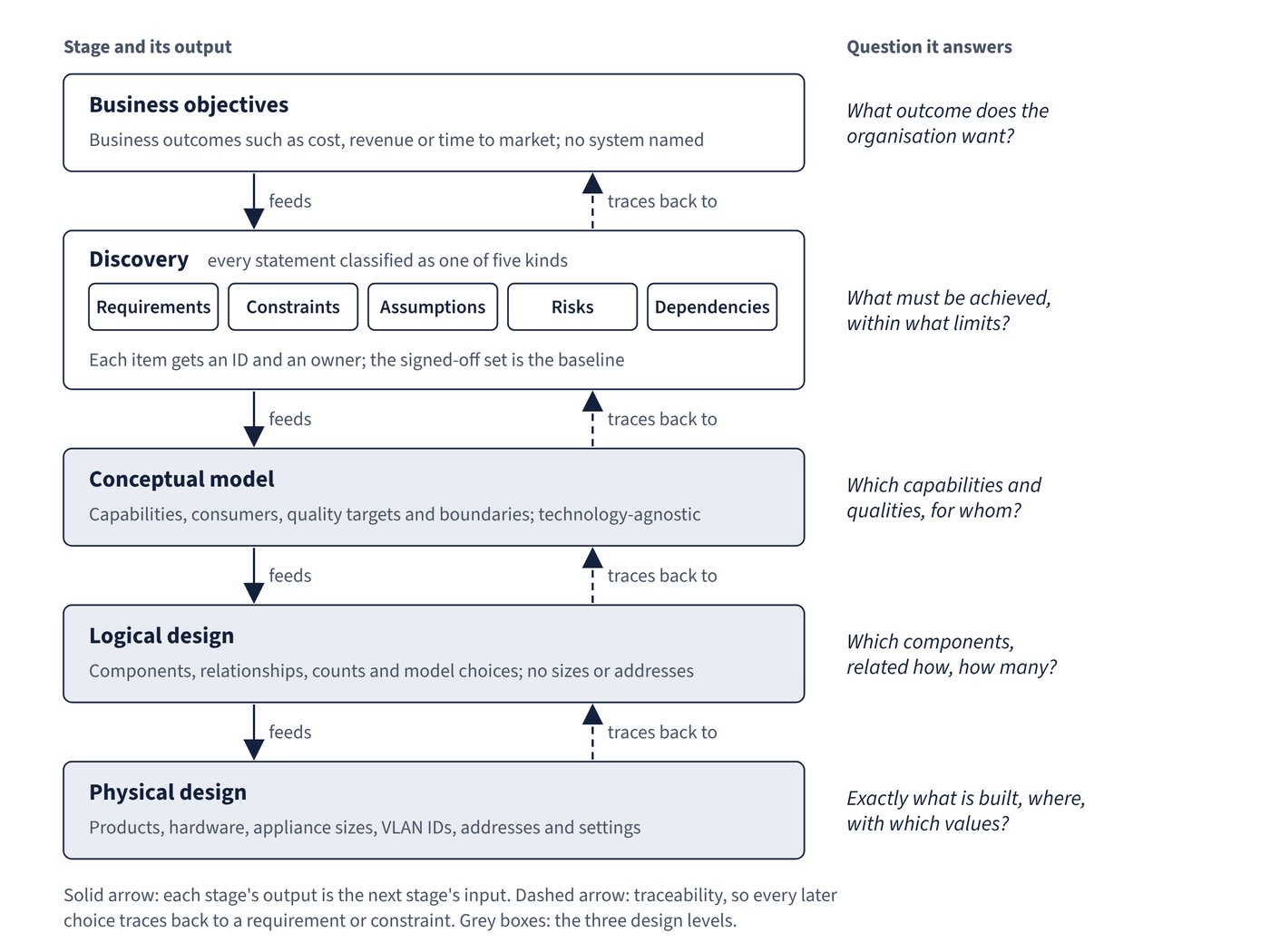
A VCF architecture starts with what the business is trying to achieve, not with a cluster model. This chapter sets out the design method the rest of the book relies on: how business objectives become business and technical requirements, how to separate requirements from constraints, assumptions, risks and dependencies, and how a design moves from a technology-free conceptual model to a logical design and then a physical design. Each step is tied to the way the VMware Cloud Foundation (VCF) 9.0 design guidance is organised, so you can see where design profiles, architectural options, design blueprints and the design library fit.
A comparison table · Chapter 1: The design method: requirements, conceptual, logical and physical design · From business objective to physical design
The exam’s candidate description sums up the skill being tested: translating business objectives into a technical solution while weighing availability, manageability, performance, recoverability and security (AMPRS), telling conceptual, logical and physical designs apart, telling business from technical requirements, and identifying risks, assumptions, dependencies and constraints. It also expects you to understand how your decisions affect the wider VMware estate and the customer’s technology landscape.
| Stage | Question it answers | Main output |
|---|---|---|
| Discovery | What must be achieved, within what limits? | Requirements, constraints, assumptions, risks, dependencies |
| Conceptual model | Which capabilities and qualities, for whom? | Technology-free model traced to requirements |
| Logical design | Which components, related how, how many? | Components, relationships, design decisions |
| Physical design | Exactly what is built, where, with which values? | Hardware, sizes, VLANs, addresses, settings |
| Validation | Does the result meet the requirements? | Test plan, results, sign-off |
A common trap · Chapter 1: The design method: requirements, conceptual, logical and physical design · From business objective to physical design
Common trap: Opening discovery with a product answer, such as settling on a stretched cluster in the first workshop - a stretched cluster is a logical and physical response to an availability requirement that may not exist; capture the requirement first, then compare the options that meet it.
Want more? Amazon offers a longer free sample of the Kindle edition on its Kindle page.


Some sections of the book, free to read online:
How to tell the five apart, what each obliges the architect to do, and worked classifications.
What belongs in a conceptual model, what doesn't, and how it traces back to business objectives.
What each design quality means, with example requirements and the VCF 9.0 design choices that serve them.
How to record a design decision so it traces to a requirement and states its implications, the way VCF design elements do.
The requirements that call for a separate workload domain, and when another cluster in an existing domain is enough.
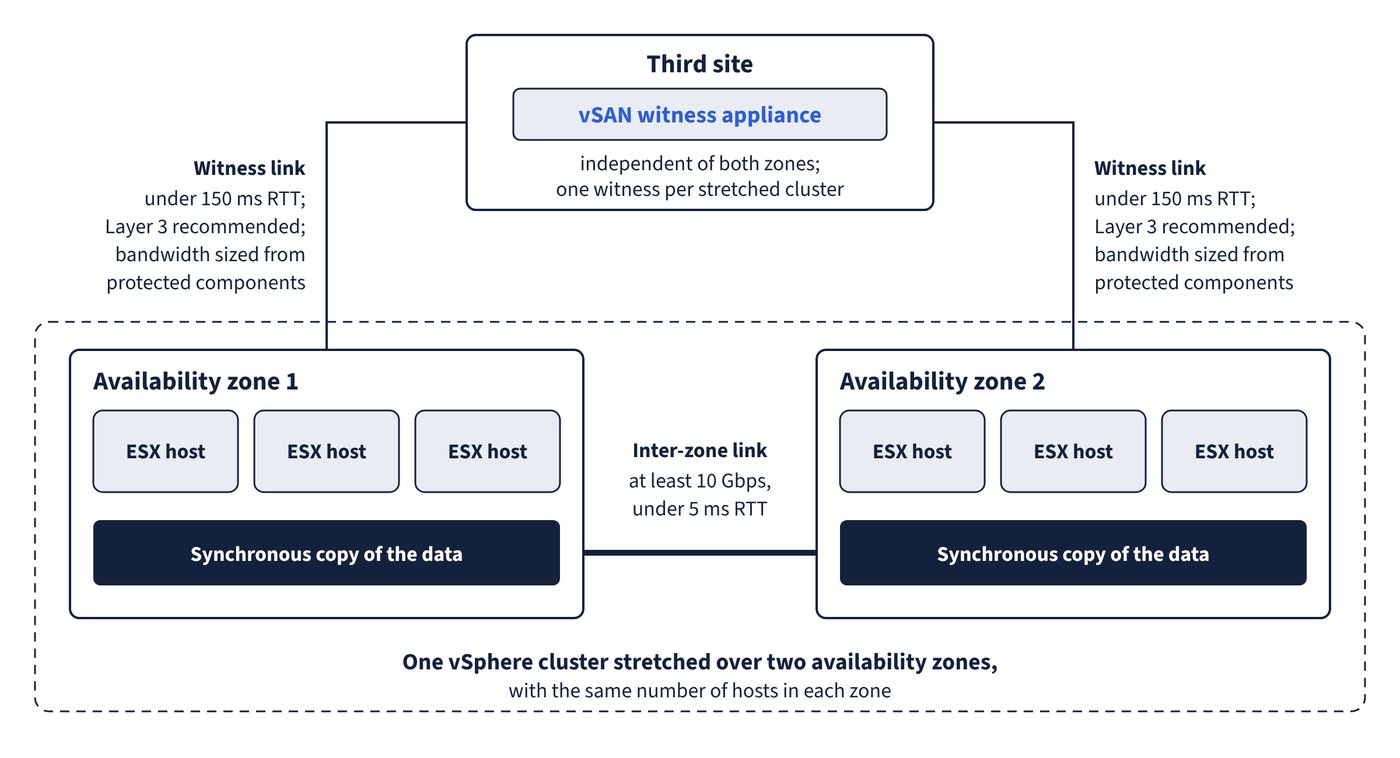
Prerequisites, latency and bandwidth limits, the vSAN witness, host counts and what fails over automatically.
Bulk, vMotion, Replication Assisted vMotion, Cold and OS Assisted Migration compared by downtime, scale and source platform.
A free week-by-week plan through the book at a 4-week or 8-week pace, with the study notes and exam skill areas for each week.