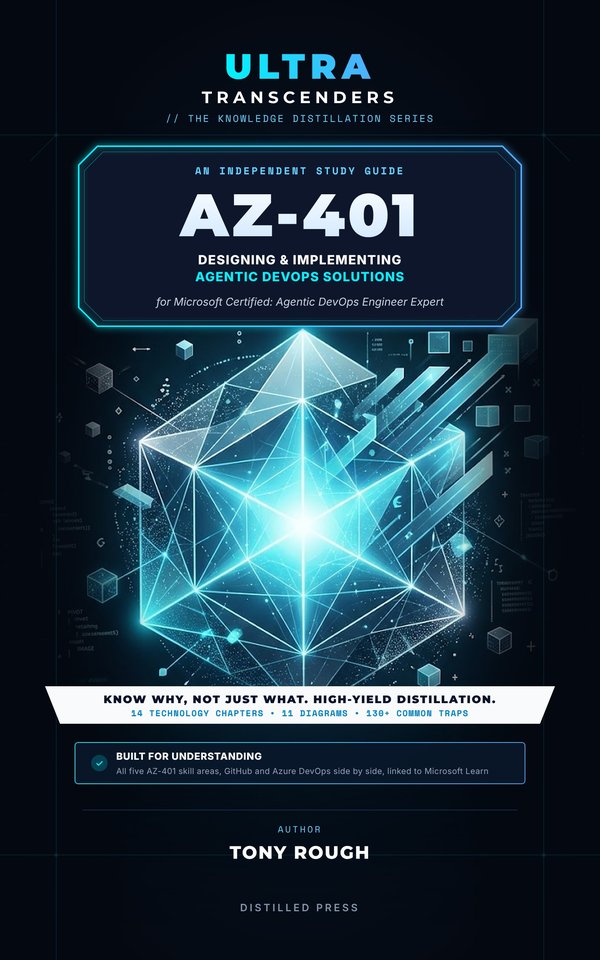
An independent study guide for Microsoft Certified: Agentic DevOps Engineer Expert · by Tony Rough
Know which agent, MCP server, pipeline feature or guard rail fits the delivery requirement, in GitHub or Azure DevOps, and why.
Free to read with Kindle Unlimited. Opens Amazon in a new tab.
Free glossary of the book's terms
First edition · published November 2026
This independent study guide for the Microsoft Certified: Agentic DevOps Engineer Expert exam distils what AZ-401 expects into the comparisons, configuration choices and traps that agentic DevOps decisions turn on. GitHub and Azure DevOps sit side by side throughout, with short YAML, Git and CLI examples.
Fourteen chapters covering all five AZ-401 skill areas:
This edition reflects Microsoft's and GitHub's documentation as of November 2026 and the AZ-401 skills measured during the beta. It uses current names, such as Copilot cloud agent (formerly Copilot coding agent), and says which features are still in preview. If the outline changes when the exam becomes generally available, the book will be updated.
This book contains no exam questions. It explains the knowledge the exam expects, so you can answer questions you have never seen and make the same calls in real pipelines and agent set-ups.
Written by Tony Rough, a cloud architect with more than twenty years in IT infrastructure who holds the Azure Solutions Architect Expert, Azure Administrator and Azure Security Engineer certifications.
Part of the Ultra Transcenders series from Distilled Press. An independent publication, not affiliated with, sponsored by or endorsed by Microsoft Corporation or GitHub, Inc.
Every skill area in Microsoft's AZ-401 outline, and the chapters that cover it.
| Skill area | Weight | Chapters |
|---|---|---|
| Design and implement processes and communications | 15–20% | 1, 2, 3, 4, 6 |
| Design and implement a source control strategy | 10–15% | 5, 6 |
| Design and implement build and release pipelines | 35–40% | 7, 8, 9, 10, 11 |
| Design and implement a security and compliance plan | 15–20% | 12, 13 |
| Implement an instrumentation strategy | 15–20% | 2, 14 |
Plus an appendix glossary of 400+ terms, each linked to Microsoft Learn, with the same terms explained free online for print readers.
Short excerpts from the book, exactly as they appear in it, so you can see how it explains things.
The opening of chapter 1 · Chapter 1: Flow of work, traceability and Azure Boards
Every DevOps design starts with a decision about how work enters the system, how it moves, and how anyone can later prove what happened to it. This chapter covers the structure of that flow across the plan, build, deploy and operate phases, the choices inside Azure Boards and GitHub for tracking it, the feedback loops that keep people informed, and the links that tie a requirement to the commits, pull requests, builds and deployments that delivered it. It also shows where AI agents now sit inside that flow, such as starting GitHub Copilot cloud agent (formerly Copilot coding agent) straight from a work item.
A comparison table · Chapter 1: Flow of work, traceability and Azure Boards · Designing the flow of work across plan, build, deploy and operate
| Phase | What the team does | Typical system of record | Where agents now help |
|---|---|---|---|
| Plan | Define features, build backlogs, track bugs, run Scrum or Kanban, visualise progress on dashboards | Azure Boards work items or GitHub Issues and Projects | Querying and updating backlogs in natural language through the Azure DevOps MCP Server |
| Build (develop) | Write, test, review and integrate code; build artefacts; collaborate through Git | Azure Repos or GitHub repositories, pull requests | Copilot cloud agent turns a work item or issue into a branch and a draft pull request |
| Deploy (deliver) | Release through stages with manual approvals and automated gates; provision infrastructure as code | Azure Pipelines or GitHub Actions, environments | Agents read pipeline and test results through MCP tools |
| Operate | Monitor, troubleshoot, keep systems reliable and secure | Azure Monitor, Application Insights, incident work items | AI operations agents investigate alerts and telemetry |
A common trap · Chapter 1: Flow of work, traceability and Azure Boards · Designing the flow of work across plan, build, deploy and operate
Common trap: Treating the four phases as role boundaries, with planners planning and operators operating - Microsoft’s guidance says the phases aren’t role-specific and every role takes part in each phase to some extent; design the flow so feedback from operations reaches the backlog.
Want more? Amazon offers a longer free sample of the Kindle edition on its Kindle page.
Some sections of the book, free to read online:
How the Azure DevOps MCP server runs locally or remotely, signs in and limits which tools an agent can call.
What stops the Copilot cloud agent doing harm: its branch, firewall, workflow approval, reviewer rules and who can assign it work.
How a Markdown agentic workflow compiles to a lock file, runs read-only and writes back only through declared safe outputs.
How the branching models differ, and which fits a team's release cadence and its use of coding agents.
How to create Azure SRE Agent, scope its managed identity and choose run modes and response plans.
How workload identity federation lets a workflow sign in to Azure with no stored secret, and which subject claims to trust.
How blue-green, canary, ring and progressive exposure differ in how fast they widen exposure and how each rolls back.
How the two package platforms compare on feeds, upstream sources, permissions and billing.
A free week-by-week plan through the book at a 4-week or 8-week pace, with the study notes and exam skill areas for each week.