VM high availability (HA) restarts VMs after a host failure, and the default gives no guarantee that they will all fit. Enabling the reservation is what changes that.
| Mode | Resources reserved | Admission control | Behaviour on failure |
|---|---|---|---|
| Best effort (default) | None | None | VMs restart wherever there is free space, and migrate back when the host returns |
| Guarantee (segment-based reservation) | Enough segments for any host failure | Yes | Restart is guaranteed for VMs within the reservation |
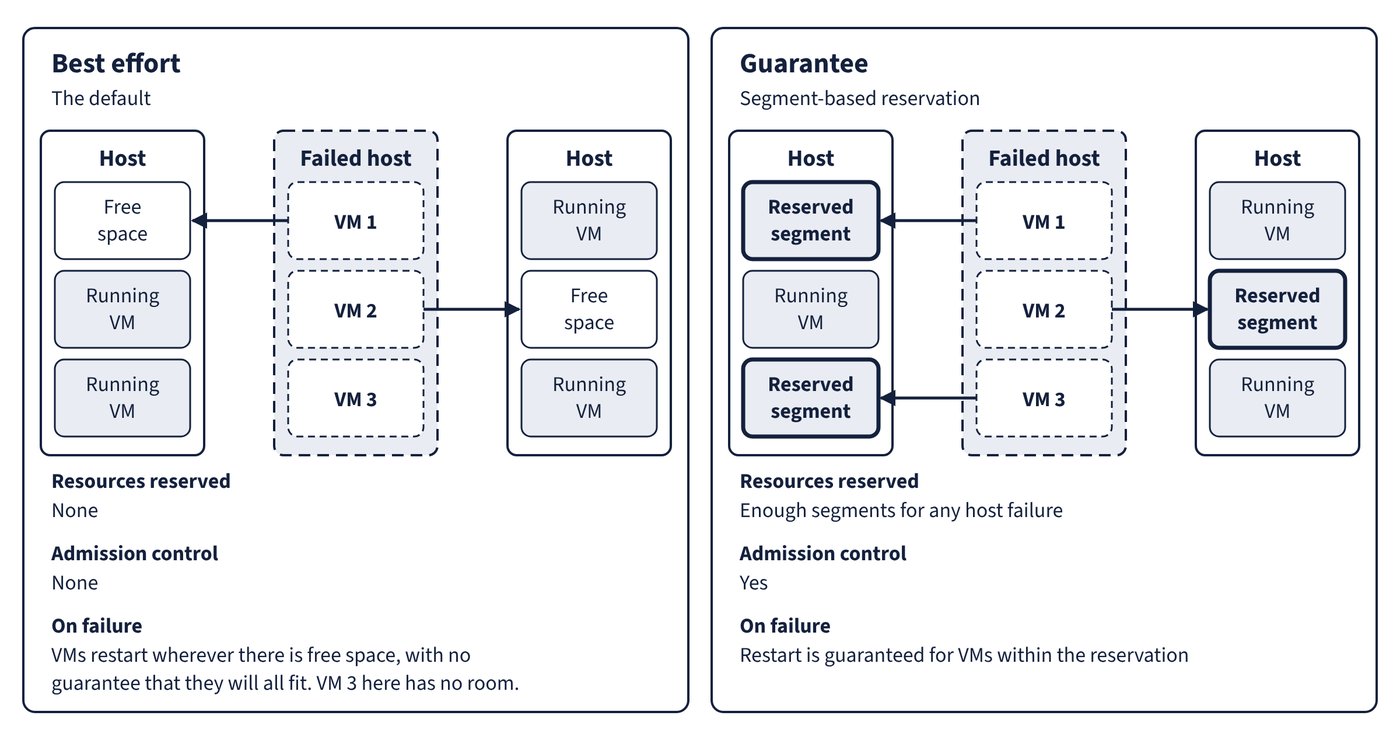
Enable it in Prism Element at Settings > Manage VM High Availability > Enable HA Reservation. Each segment corresponds to the largest VM guaranteed to restart. The amount reserved is typically 1 to 1.25 times the resource usage on the most loaded host, and it is recomputed when the cluster changes. The older host-based method is no longer supported. Figure 6.1 shows the difference when a host fails.
A host is marked disconnected if a management service heartbeat is lost, or if its root file system is corrupt or read-only. After 40 seconds in that state, its VMs are restarted, subject to resources. Cluster HA status then moves through these states.
| Status | Meaning |
|---|---|
| OK | Protected against a host failure |
| Healing | VMs are being restarted, or locality is being restored after the host returns |
| Critical | No further host failure can be tolerated; VM start and migrate operations are restricted |
Limits to remember:
- A VM needs at least one vDisk in a Nutanix storage container to be protected.
- HA does not reserve memory for non-migratable VMs.
- vGPU VMs get no reserved memory or vGPU resources, and restart on commercially reasonable effort if an identical profile is free on another host.
- During maintenance mode, migrations use the reservation, so the cluster might not be protected against another failure at that time.
Common trap: Believing AHV guarantees restart of every VM out of the box - the default is best effort with no reservation or admission control, and a guarantee requires the HA reservation to be enabled.