The ADM Techniques chapter on Architecture Alternatives and Trade-offs gives a structured way to make these choices.
Why alternatives are worth presenting
More than one Target Architecture can satisfy the Architecture Vision, principles and requirements. Identifying the alternatives helps the team understand what is possible and the trade-offs between competing forces. Presenting them to stakeholders has a further benefit: it draws out hidden agendas, principles and requirements that would otherwise stay buried. The technique can be used in any phase and at any level, is often applied per domain with the results then merged, and needs only enough detail to support the decision.
Common trap: Presenting stakeholders with a single recommended option - offering alternatives is what reveals hidden agendas, principles and requirements.
The three parts
| Part | Purpose | What is done |
|---|---|---|
| 1 Define criteria | Agree how alternatives will be judged | Derive criteria from the Vision, the principles, the requirements and stakeholder concerns |
| 2 Identify alternatives | Understand each option and its consequences | For each alternative: define overview criteria; describe the architecture with the necessary views; estimate gaps from baseline; understand impacts and trade-offs across the Landscape |
| 3 Choose | Select or combine with stakeholders | Weigh strengths and weaknesses against the criteria; select the best fit, or merge features into a fresh alternative jointly with stakeholders; finalise it; agree the alternative and its funding at a formal stakeholder review |
Typical criteria
The Standard lists the kinds of alternative that criteria may favour:
| Criterion | What it tests |
|---|---|
| Flexibility | Whether the alternative stays adaptable |
| Time and cost of realisation | Including transitions and plateaus, the “islands of stability” along the way |
| Benefit period | The time period over which benefits are achieved |
| Architecture styles and guidelines | How closely the alternative follows them |
| Solution delivery method | Reuse, develop or buy |
| Business impact during implementation | How little the alternative disturbs business capabilities while being built |
| Risk | How far risk is minimised and mitigated |
The advantages and disadvantages of each alternative are discussed and agreed with stakeholders. Extra viewpoints and views may be needed to show dependencies, risks and uncertainties.
Identifying each alternative
For each alternative the team:
- defines overview criteria, which can apply at different levels of abstraction and in different phases;
- describes the architecture with the views needed, avoiding excessive detail but supporting good impact assessment and showing interdependencies;
- estimates the gaps from baseline to the alternative, informally if the baseline has not yet been defined;
- works out impacts and trade-offs across the Architecture Landscape.
The impact check covers existing and Transition Architectures; running and planned implementation projects, including constraints those projects impose; other ADM phases in the same project; requirements or Change Requests the alternative would place on other architectures; and the final value delivered, how much of the gap it closes and the purpose of the iteration.
Choosing and assembling
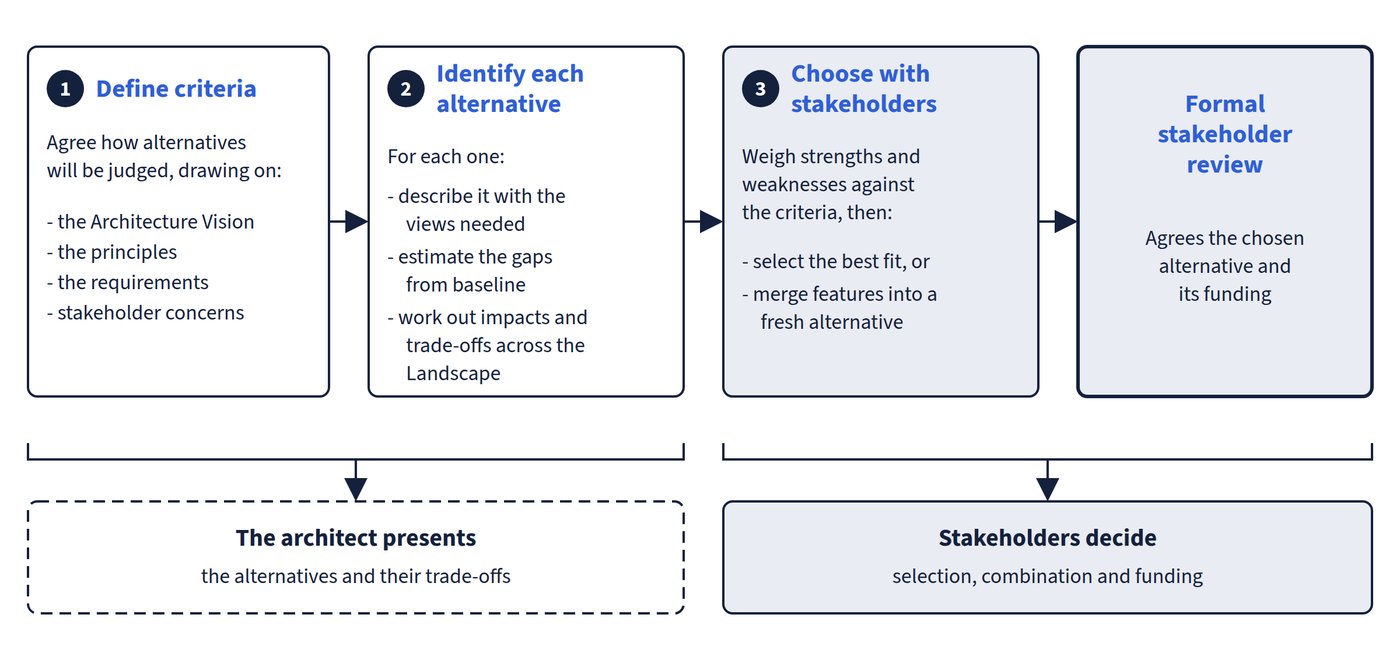
Trade-off analysis resolves conflicts by comparing strengths and weaknesses against the criteria. The team then selects the most suitable alternative or, with stakeholders, combines features into a new one. Assembling the result involves completing its description, covering every viewpoint identified, giving enough detail to decide, resolving Landscape impacts and, finally, a formal stakeholder review at which the alternative and its funding are settled. Figure 6.1 brings the three parts and the closing review together.
Common trap: The architect selecting the best alternative alone and presenting it for approval - selection or combination happens with stakeholders, and a formal stakeholder review decides both the alternative and its funding.