The ADM Techniques chapter on Stakeholder Management describes the discipline of winning support from others. It is first applied in Phase A to locate the key players and is then revisited in every phase, because new stakeholders can appear later, for instance in Phases E, F and H.
Why it matters
The technique brings several benefits:
- the most powerful stakeholders are found early, so their input can shape the architecture, which wins their support and improves the models;
- the backing of powerful stakeholders helps secure more resources;
- communicating early and often helps stakeholders understand the process and its benefits, so they support it more actively;
- the team can anticipate reactions to models and reports, building on positive ones and dealing with negative ones;
- conflicting or competing objectives surface early, so their resolution can be planned.
Beneath this lies a simple analysis of who contributes, who gains and who loses, with a strategy for each.
The Standard compares this to a building architect, who draws wiring diagrams for electricians, floor plans for owners and elevations for planning officials: one building, several views.
The four steps
| Step | Purpose | What is done |
|---|---|---|
| 1 Identify stakeholders | Know who is affected, who has power or influence, and who cares whether the work succeeds | List the groups and then the individuals within them; look beyond the formal structure |
| 2 Classify stakeholder positions | Understand each stakeholder’s current and required position | Rate how far each could disrupt the change, their understanding and commitment now and as needed, and the support required (high, medium or low) |
| 3 Determine stakeholder management approach | Choose how to engage each stakeholder | Place each stakeholder on the power/interest grid by power, influence and interest |
| 4 Tailor engagement deliverables | Let each group check its concerns are addressed | Decide which catalogs, matrices and diagrams each group receives and validates |
Step 1 in practice. Useful questions include who stands to gain or lose, who runs process change, who designs the new systems, who decides, who buys IT, who holds the resources and who has specialist skills. The Standard warns against relying too heavily on the formal organisation structure, because informal groups can be just as powerful. Individuals belong to several groups, and groups can form around events. Influencers are often well respected, rising in the organisation, present at important meetings and committees (minutes can reveal them), well informed and valued by peers and superiors, without necessarily holding formal power. In the end, communication is with people, so the right individuals within each stakeholder organisation must be found. The analysis should cover both the visible team, obviously associated with the work, and the invisible team that must contribute without being obviously connected, such as support services.
Step 2 in practice. Beyond the six recorded attributes, the practitioner assesses readiness: how ready is the stakeholder to move towards the Target, could they act as a credible advocate, how closely do they want to be involved (observing or working in the detail), and do they have a contractual commitment to development and governance? For stakeholders whose commitment is critical, the gap between current and desired commitment needs particular attention.
Common trap: Basing stakeholder identification only on the organisation chart - informal groups and influencers without formal power can be as important as the formal hierarchy.
The power/interest grid
Some stakeholders can block or advance the work, and some care about it while others do not. Plotting them shows who is a potential blocker or critic and who a potential advocate or supporter, and points to an engagement strategy. Figure 5.1 shows the grid and the strategy for each square.
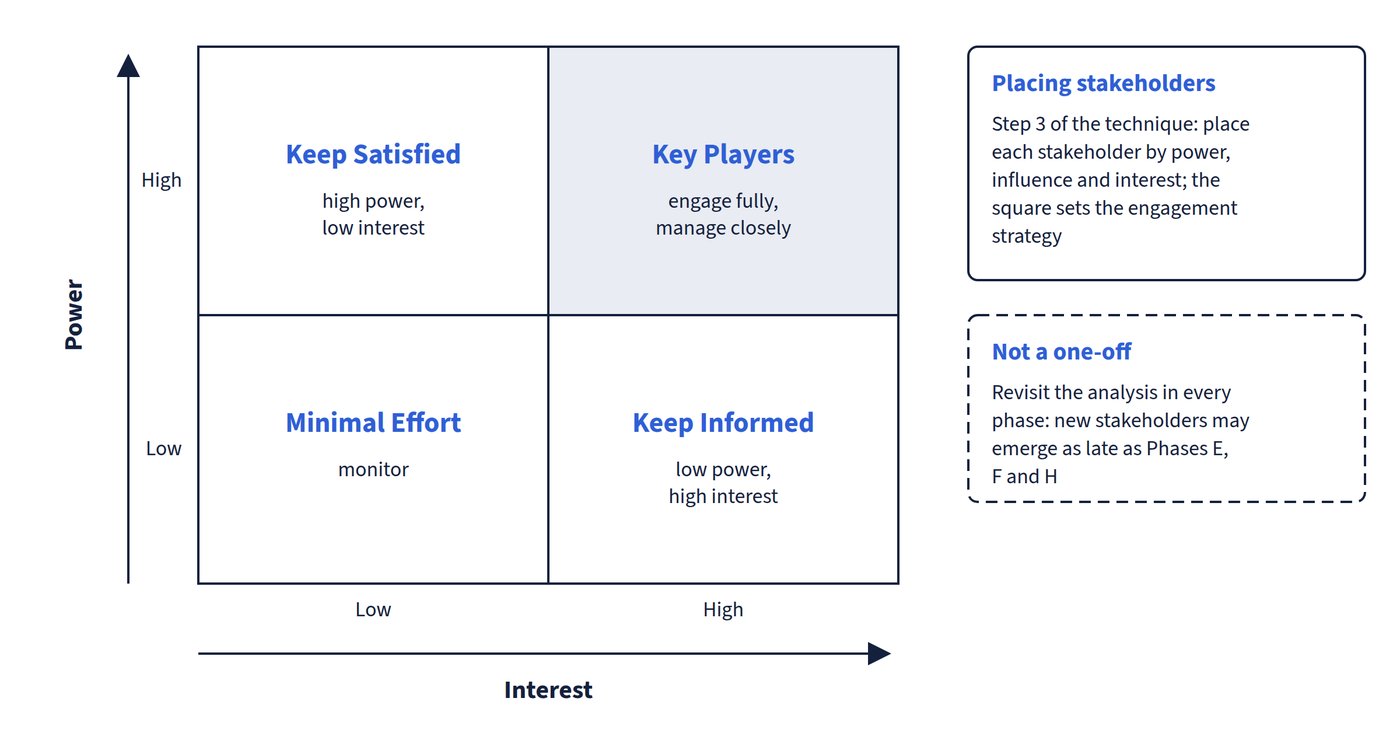
| Low interest | High interest | |
|---|---|---|
| High power | Keep Satisfied | Key Players (engage fully, manage closely) |
| Low power | Minimal Effort (monitor) | Keep Informed |
Common trap: Engaging a powerful but uninterested executive in detailed working sessions - the grid places them in Keep Satisfied, so they need concise, high-level material rather than full engagement.
Common trap: Doing stakeholder analysis once in Phase A and filing it - the analysis is updated in every phase, and new stakeholders may emerge as late as Phases E, F and H.