Step 8 sets the overall shape of change. It is done in two layers: first the strategic approach, then the methodology for pursuing the strategic direction. Together with the dependencies, these choices form the basis for the work packages, and the step ends with agreement on the Implementation and Migration Strategy.
The three basic approaches
| Approach | Meaning | Planning implication |
|---|---|---|
| Greenfield | A completely new implementation | There is no existing system to migrate from |
| Revolutionary | Radical change: the new is switched on and the old switched off | A single cut-over, so migration risk and back-out need explicit planning |
| Evolutionary | Convergence, through parallel running or phased introduction | Suits incremental delivery through Transition Architectures that each add value |
Implementation methodologies
Having chosen the approach, the architect selects a way of addressing the strategic direction that takes account of the risks. The most common are:
- Quick win (snapshots);
- Achievable targets;
- Value chain method.
Judging which fits
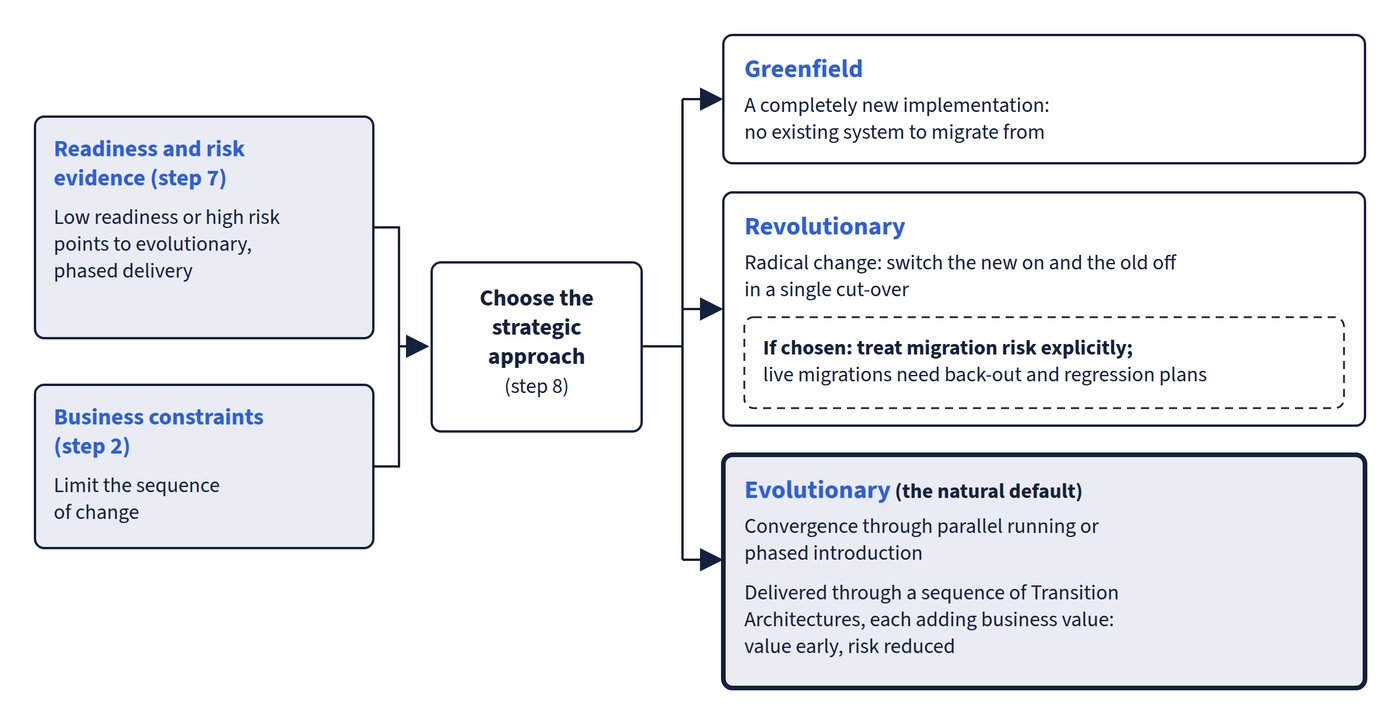
- Look at the readiness and risk evidence from step 7. Low readiness or high risk points towards evolutionary, phased delivery with Transition Architectures.
- Look at the business constraints from step 2, which limit sequence.
- The Phase G approach in the Standard favours rolling out the Target through a sequence of transitions, every one of which brings its own business benefit, as the way to realise value early and reduce risk. An evolutionary approach is therefore the natural default unless the situation gives a strong reason for something else.
- If a revolutionary cut-over is chosen, migration risk needs explicit treatment; for live migrations the Series Guide requires back-out and regression planning (see Chapter 11, Phase F: Migration Planning, Value and Viability). Figure 10.1 brings these points together.
Common trap: Confusing the strategic approach (Greenfield, Revolutionary, Evolutionary) with the implementation methodology (Quick win, Achievable targets, Value chain method) - they are two separate decisions made in that order within step 8.
Common trap: Choosing a revolutionary approach because the sponsor wants the Target quickly - wanting speed is not the same as being able to absorb change; readiness and risk evidence should drive the choice.