On vSAN, the storage policy is the configuration: it decides how many copies or parity fragments each object has, where they go and which data services apply. A VM on vSAN always carries at least one policy; if none is picked, the datastore default is used.
Policy rules
| Rule | What it controls | Default and range |
|---|---|---|
| Site disaster tolerance | None (standard cluster), Host mirroring (two-node), Site mirroring (stretched), or keep data on Preferred / Secondary site only | None - standard cluster |
| Failures to tolerate (FTT) | Host or device failures an object survives, plus the method: RAID-1 mirroring or RAID-5/6 erasure coding | 1 failure, RAID-1 |
| Number of disk stripes per object | Minimum capacity devices each replica is striped across | 1; maximum 12 |
| IOPS limit for object | Throttles an object above the limit (I/O weighted at 32 KB) | 0 = no limit |
| Object space reservation | Share of the VMDK reserved (thick provisioned) | Thin; 25%, 50%, 75% or thick |
| Flash read cache reservation | Read cache reserved per object | 0%; hybrid OSA only |
| Disable object checksum | Turns off end-to-end checksum | No (checksum on); always on in ESA |
| Force provisioning | Provision even when the policy cannot be met | No |
| Encryption services, space efficiency, storage tier | Datastore matching rules (useful with remote datastores) | No preference |
FTT and RAID choices
| Policy | Minimum hosts or fault domains | Capacity for 100 GB of data |
|---|---|---|
| No data redundancy (FTT=0) | Not applicable | 100 GB (unprotected) |
| 1 failure, RAID-1 | 3 | 200 GB |
| 1 failure, RAID-5, OSA | 4 | 133 GB |
| 1 failure, RAID-5, ESA with fewer than 6 hosts (2+1) | 3 | 150 GB |
| 1 failure, RAID-5, ESA with 6 or more hosts (4+1) | 6 for 4+1 | 125 GB |
| 2 failures, RAID-1 | 5 | 300 GB |
| 2 failures, RAID-6 | 6 | 150 GB |
| 3 failures, RAID-1 | 7 | 400 GB |
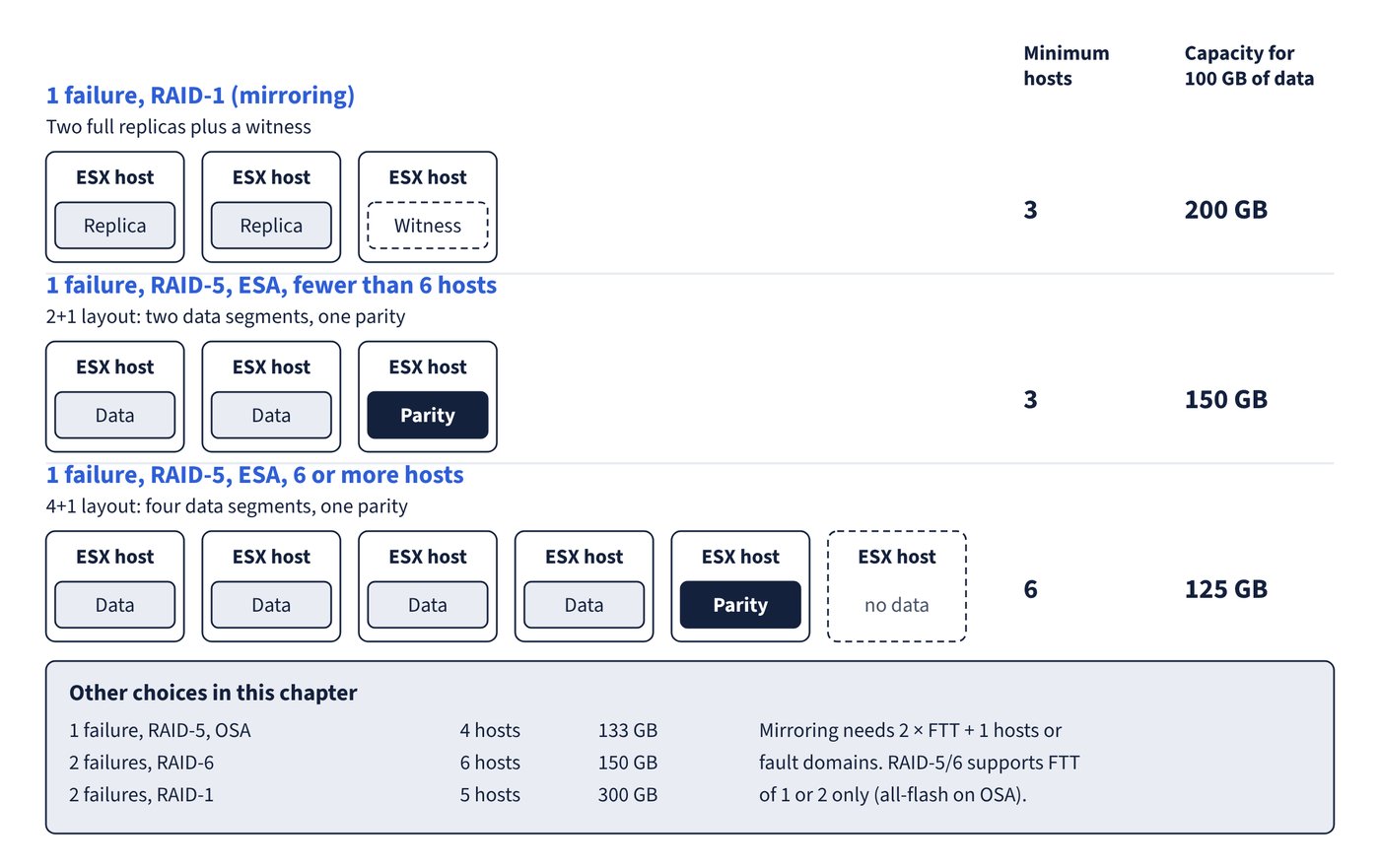
Mirroring needs 2 × FTT + 1 hosts or fault domains. RAID-5/6 requires all-flash (on OSA) and supports FTT of 1 or 2 only, never 3; RAID-1 gives better performance and faster resynchronisation, erasure coding uses less capacity. On ESA, vSAN readjusts the RAID-5 layout automatically 24 hours after the cluster grows past or shrinks below six hosts. In a stretched cluster, RAID-5/6 applies only to the protection within each site. Figure 6.2 shows how the components of each layout are spread across hosts.
Default policies and auto-policy management
The vSAN Default Storage Policy has FTT=1, one stripe and thin provisioning (object space reservation 0); it cannot be deleted or renamed, but its rules can be edited, and it applies only to vSAN datastores. VM swap and snapshot memory objects get FTT=1 with force provisioning. In ESA, RAID-0 and RAID-1 objects actually use three stripes even when the policy says one.
Auto-policy management (ESA only, under vSAN > Services > Storage) generates “ClusterName - Optimal Default Datastore Policy”, picking site tolerance and FTT to suit whether the cluster is standard or stretched and how many hosts it has, then assigns it as the datastore’s default. Under auto-policy management a RAID-5 policy is chosen from four hosts and RAID-6 from six, even though ESA RAID-5 itself runs on three.
vSAN queues policy edits and applies them in the background so that temporary space use stays bounded, but refuses at once any edit the hardware cannot honour, such as moving from RAID-5 to RAID-6 on five hosts. Changing stripe width or the protection method can rebuild objects and trigger resynchronisation.
Common trap: Assuming RAID-5 needs at least four hosts on every vSAN cluster - that is the OSA rule. ESA uses a 2+1 RAID-5 layout on clusters of fewer than six hosts, so a three-host ESA cluster can use RAID-5 (four hosts are needed only when auto-policy management chooses the policy).