The choice of external connection is the central design decision for VCF Networking. Both are set up from the same simplified Network Connectivity workflow, available in vCenter and in NSX. Figure 5.1 shows the two paths from the transit gateway to the physical network.
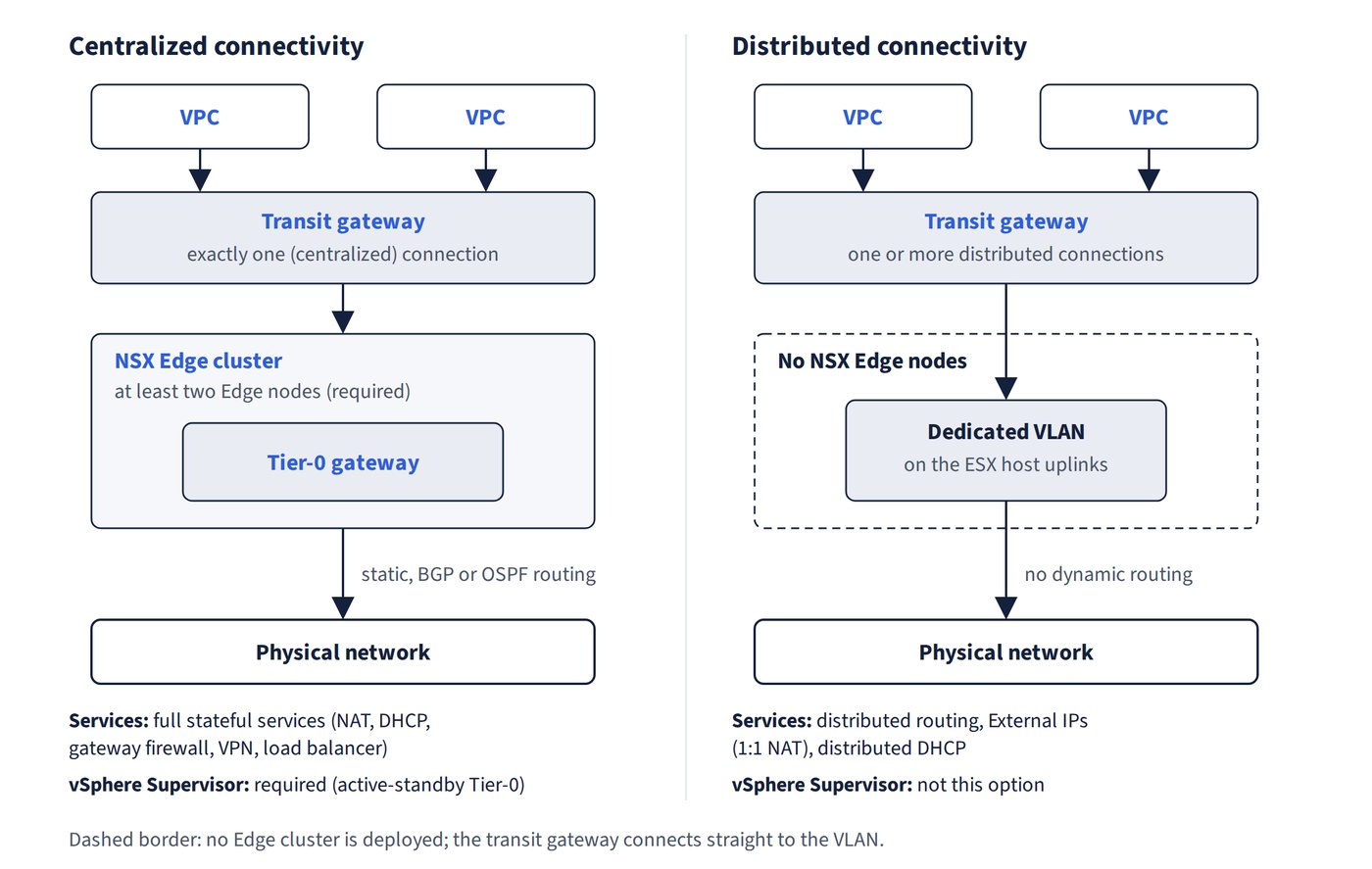
| Centralized connectivity | Distributed connectivity | |
|---|---|---|
| How the TGW reaches the fabric | Through a Tier-0 gateway on NSX Edge nodes | Directly to a VLAN on the ESX hosts (uplinks used by the NSX vmkernel) |
| Edge nodes | Required (minimum two per Edge cluster) | Not required |
| Routing with the fabric | Static, BGP or OSPF | No dynamic routing; only a dedicated VLAN, gateway CIDR and IP blocks |
| Services | Full: stateful services at Tier-0 or TGW (NAT), DHCP, gateway firewall, VPN, load balancer | On-demand networking, distributed routing, External IPs (1:1 NAT) and distributed DHCP |
| DHCP server mode | Centralized or distributed (default distributed) | Distributed only; DHCP relay not supported |
| Connections per TGW | Exactly one | One or more |
| vSphere Supervisor (workload domain wizard) | Required; Supervisor needs an Edge cluster with an active-standby Tier-0 | Not the option to select when the domain will run Supervisor |
Distributed connectivity requirements:
- A dedicated VLAN for external connectivity of VPC workloads, configured on all top-of-rack switches serving hosts that run VPCs and stretched across all clusters where VPCs are deployed.
- External IP blocks that are the same as, or a subset of, the VLAN subnet; in-use physical addresses must be pre-allocated in NSX to avoid duplicates.
Centralized connectivity requirements (in addition to Edge resources):
- ESX hosts with VDS uplinks, a transport node profile on the cluster, a compute manager registered with NSX Manager, an Edge TEP VLAN plan, DNS entries for Edges, and management network reachability to NSX Manager.
Common trap: Selecting distributed connectivity for a domain that will run vSphere Supervisor - the workload domain wizard states that vSphere Supervisor requires centralized connectivity (an Edge cluster with an active-standby Tier-0).