vSAN aggregates the local or direct-attached devices of a cluster’s hosts into a single shared datastore that supports HA, vMotion and DRS. It comes in two architectures, and the choice drives hardware, data services and which cluster types are possible.
| Aspect | vSAN Express Storage Architecture (ESA) | vSAN Original Storage Architecture (OSA) |
|---|---|---|
| Tiering | Single tier: every device contributes to cache and capacity | Two tiers: cache device plus capacity devices |
| Device grouping | Storage pool (one per host by default) | Disk groups: 1 flash cache device + 1 to 7 capacity devices; up to 5 disk groups (35 capacity devices) per host |
| Devices | NVMe TLC only; NVMe on Tri-Mode controllers not supported | SAS, SATA or NVMe; all-flash or hybrid (magnetic capacity) |
| Host memory | At least 128 GB | Depends on disk groups and devices |
| Network | 10 GbE minimum (only ReadyNode profile vSAN-ESA-AF-0 supports 10 GbE), 25 GbE or more recommended | 1 GbE dedicated for hybrid; 10 GbE dedicated or shared for all-flash |
| Compression | On by default, per object through storage policy, applied to new writes | Cluster-wide setting, with or without deduplication |
| Deduplication | Not available | Available on all-flash (with compression) |
| RAID-5 | Adaptive 2+1 (fewer than 6 hosts) or 4+1 (6 or more) | 3+1, needs 4 fault domains |
| Snapshots | Native scalable snapshots; base disk and snapshots in one object | Each snapshot delta is a separate object |
| Auto-policy management | Yes | No |
| vSAN storage cluster | Supported (required) | Not supported |
| TRIM/UNMAP | Enabled by default | Must be enabled |
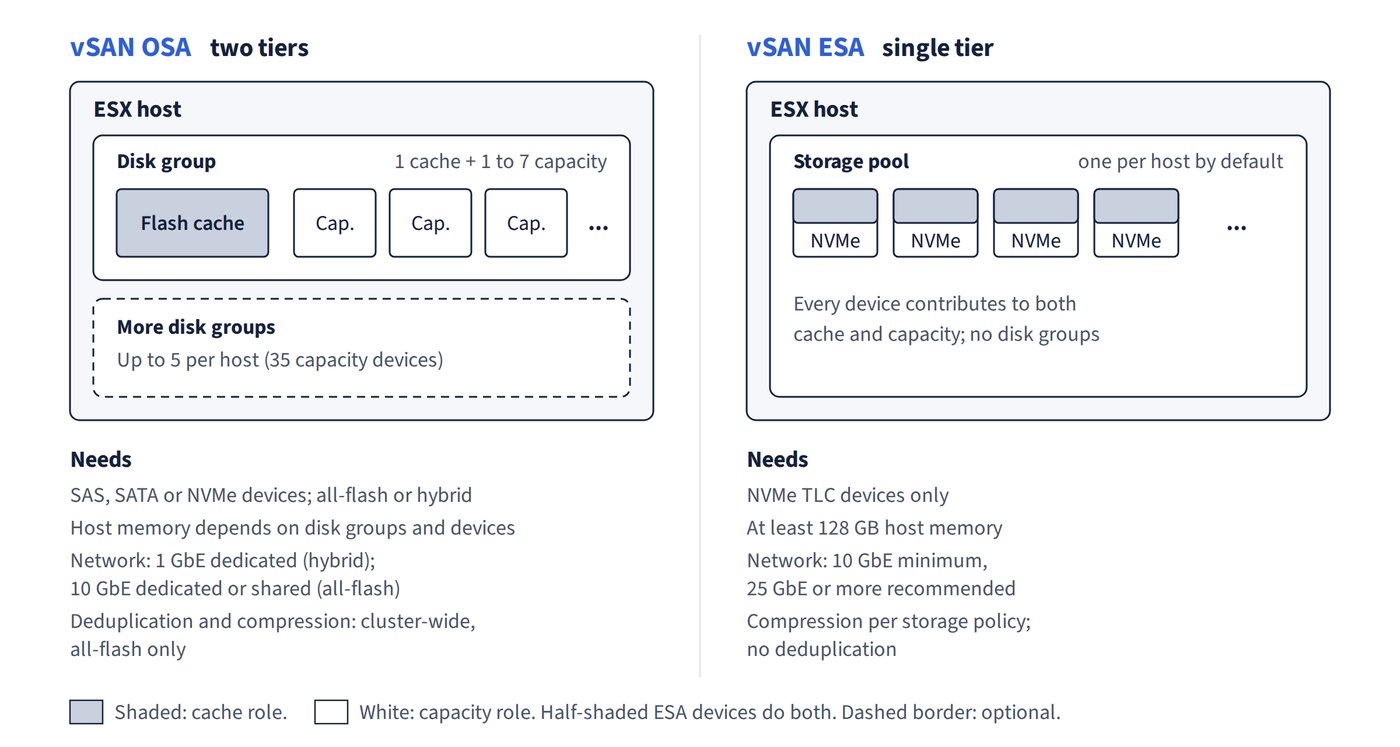
Choosing between them: vSAN ESA is the documented choice for high-performance workloads needing low latency and high IOPS, and is the only architecture for disaggregated vSAN storage clusters. vSAN OSA may be chosen when newer NVMe hardware is not available. OSA and ESA datastores cannot be shared with each other. Figure 4.1 contrasts the two device layouts and what each needs.
Common vSAN rules in VCF: all new vSAN clusters, ESA or OSA, must use vSphere Lifecycle Manager images; hardware must be on the vSAN compatibility list (non-certified ESA disks are allowed for proof-of-concept only from VCF 9.0.1); an ESX host can belong to only one vSAN cluster; and vSAN does not support Distributed Power Management, Storage I/O Control, SE Sparse disks or RDMs. From version 9, vSAN is licensed automatically when the connected vCenter is licensed, so no separate vSAN licence is assigned.
Common trap: Enabling deduplication on a vSAN ESA cluster to save space - deduplication is not available in ESA; ESA provides per-policy compression, while dedupe and compression is an OSA, all-flash, cluster-wide feature.
Common trap: Building a vSAN storage cluster on existing SAS/SATA OSA hosts - vSAN storage clusters require vSAN ESA with NVMe devices on ReadyNodes certified for storage clusters.