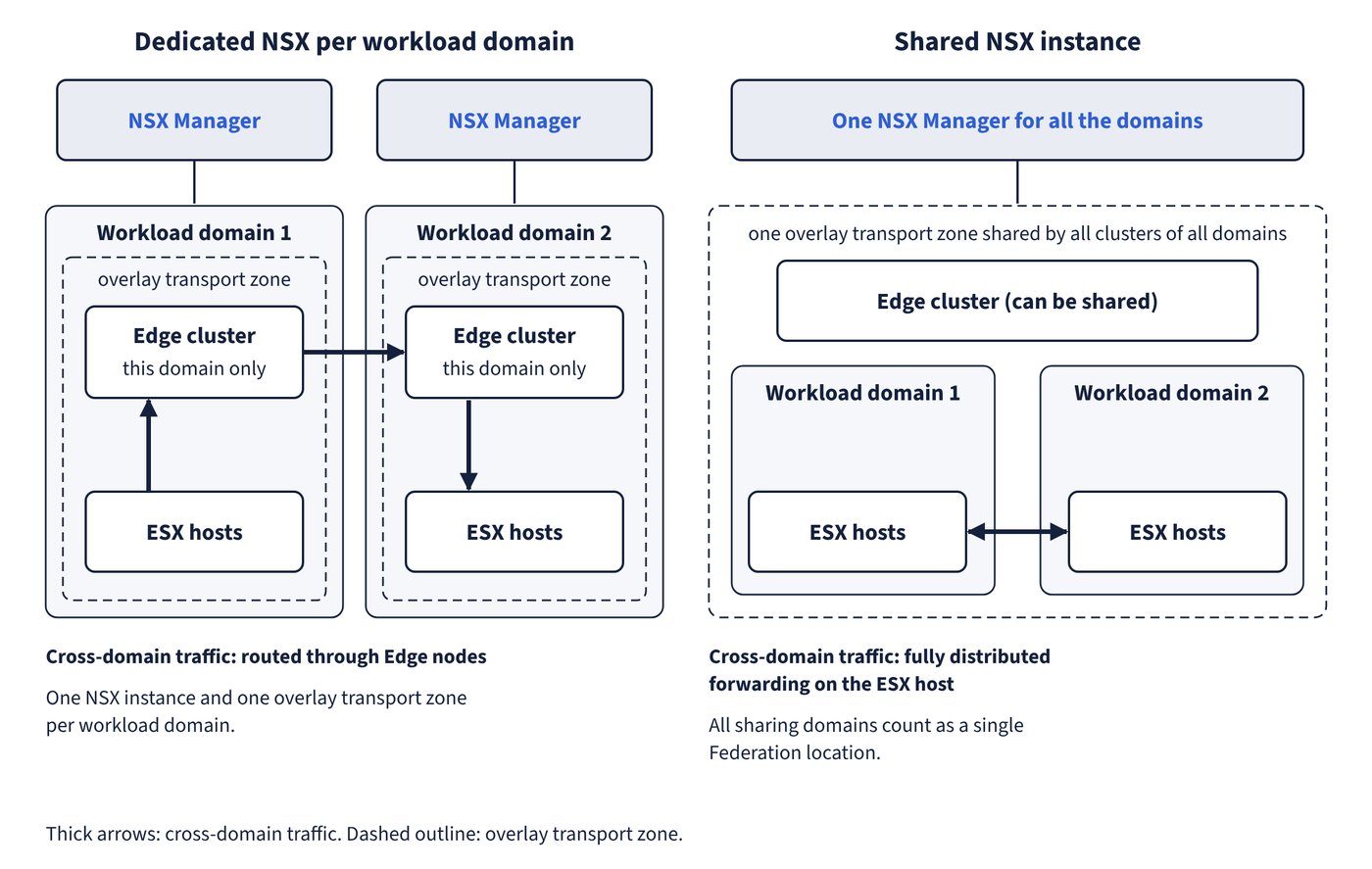
Whether workload domains share an NSX instance is the main fleet-level NSX decision. It affects forwarding, scale, blast radius and lifecycle. Figure 4.1 contrasts the two models and the path cross-domain traffic takes.
| Attribute | Dedicated NSX per workload domain | Shared NSX instance across workload domains |
|---|---|---|
| Management and control plane | Independent per domain | Single management plane and shared control plane |
| Cross-domain traffic | Routed through Edge nodes (or Federation between NSX domains) | Fully distributed forwarding on the ESX host |
| Overlay transport zone | One per NSX instance | One overlay transport zone shared by all clusters of all domains using that NSX Manager |
| Edge clusters | Serve only that domain | Can be shared across the domains that share the NSX Manager |
| VPC consumption | Per domain | Full support across the shared domains |
| Across VCF Instances | Possible only with Federation | Not supported |
| MTU | Per domain | Workload MTU plus 200 bytes end to end |
| Federation location | One location per NSX instance | All sharing domains count as a single location |
| Management plane recovery | Per instance | Provided by the underlying infrastructure |
Lifecycle impact of sharing
SDDC Manager takes resource locks during upgrades. Upgrading a workload domain’s NSX Manager takes a DOMAIN lock. With shared NSX, multiple DOMAIN locks are held and released together, so a single NSX upgrade blocks Day-N operations in every domain that shares it. Creating or deleting a workload domain that uses shared NSX is blocked while a workload domain vCenter or NSX Manager upgrade is in progress. Creating a workload domain with its own NSX is allowed. Upgrading the management domain NSX Manager takes a SYSTEM lock, which blocks all Day-N operations in the instance.
Choosing
- Share NSX when domains in the same VCF Instance need one security policy, distributed east-west forwarding between domains, and shared Edge clusters or VPC consumption.
- Use dedicated NSX when domains need isolation of control plane, upgrade schedule and failure domain. Add Federation if they also need stretched networks or common security across instances.
Common trap: Expecting traffic between two workload domains on a shared NSX instance to hairpin through Edge nodes - with a shared NSX instance, cross-domain traffic is fully distributed on the hosts. Traffic goes through Edge nodes in the Federation model.