Equal-Cost Multi-Path (ECMP) lets a Tier-0 use several equal routes at once, so north-south throughput scales with the number of Edge nodes and a single uplink or Edge failure removes only some paths. NSX has ECMP in two places, and they are configured separately. Figure 15.2 shows where each kind of ECMP works.
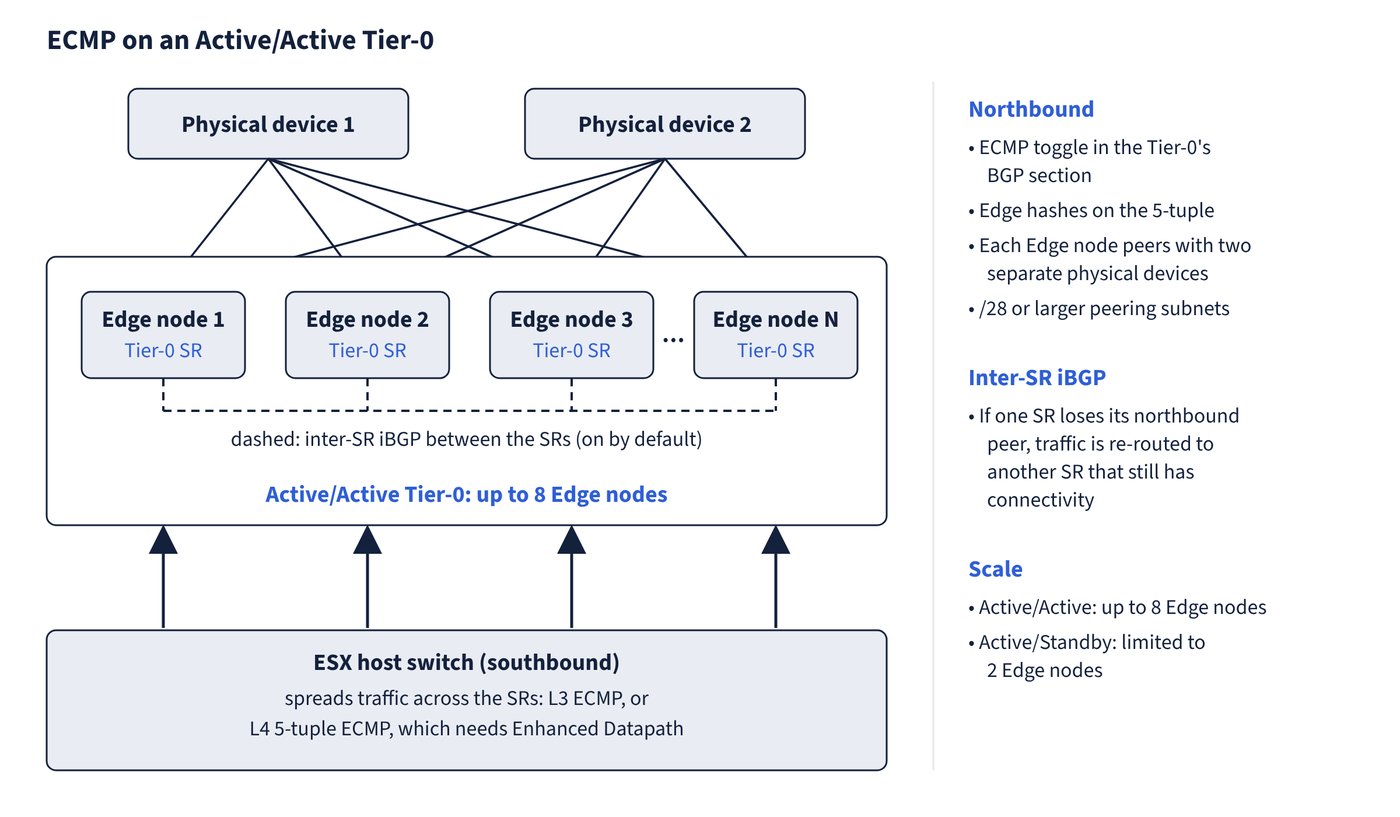
ECMP on the Tier-0 (northbound)
- HA mode: ECMP across Edge nodes needs a Tier-0 in Active/Active mode. Active/Active is the default HA mode when adding a Tier-0; traffic is load balanced across all members. In Active/Standby, all traffic is processed by the single elected active member.
- Toggle: the ECMP toggle is in the Tier-0’s BGP section. Multipath Relax load-shares across paths that differ only in AS-path values but have the same AS-path length, and needs ECMP enabled.
- Hashing on the Edge: ECMP on NSX Edge is based on the 5-tuple: protocol number, source and destination address, and source and destination port.
- ADD-Path: the Tier-0 advertises receive-only ADD-Path by default. If the same prefix arrives several times with the same metric and ECMP is enabled, all paths are installed and active; if the metrics differ (for example a longer AS path) only the best path is installed and the others stay in the BGP table to speed convergence.
- OSPF: OSPF ECMP is supported up to a maximum of 8 paths.
- Scale: the design library says an Active/Active Tier-0 can scale to 8 Edge nodes, recommends /28 or larger peering subnets to allow that growth, and notes that an Active/Standby Tier-0 is limited to 2 Edge nodes. Each Edge node should peer with two separate physical devices so a switch failure is handled by routing rather than an Edge failover.
ECMP from the host to the Edges (southbound side)
The L4 ECMP in the ESX host switch feature is different from northbound ECMP. It decides how a host spreads traffic across the available SRs.
| Mode | Hash | Requirements and notes |
|---|---|---|
| L3 ECMP | Layer 3 | Applied to a transport node or through a transport node profile (not at sub-TNP level; sub-TNPs inherit the TNP setting) |
| L4 ECMP (5-tuple) | Source and destination IP, IP protocol, source and destination L4 port | Requires Enhanced Datapath (Standard or Dedicated); disabled by default; enabled globally with lb_ecmp: true on /policy/api/v1/infra/connectivity-global-config; applies to all ESX hosts |
Enabling 5-tuple ECMP significantly increases the number of flows on EDP hosts, and performance can suffer when the flow limit is reached. Do not enable it with non-EDP hosts or a mix of EDP and non-EDP hosts; validations prevent enabling it for non-ENS switches.
Inter-SR iBGP
An Active/Active Tier-0 supports inter-SR iBGP (enabled by default, not available in Active/Standby). If one SR loses its northbound peer, traffic is re-routed to another SR that still has connectivity. A route learned from a northbound router is always preferred over the same route learned over inter-SR iBGP, and this preference cannot be changed. For VRF gateways, inter-SR routing also needs the Multi-VRF Inter SR toggle on the parent Tier-0 (it causes disruption to inter-SR and inter-site traffic when turned on, and cannot be turned off) plus Inter SR iBGP on the VRF.
Symmetry and uRPF
ECMP means return traffic may arrive on a different Edge from the one that sent it. uRPF on Tier-0 external interfaces is Strict by default. For symmetric routing, every Edge node in a Tier-0 must advertise the same prefixes and learn the same prefixes from the top-of-rack switches, and route maps and filters must be consistent inbound and outbound on all Edge nodes. The design library separates asymmetric routing, which is normal in ECMP and supported by the RPF check, from asymmetric route advertisements from the physical switches, which trigger the RPF check and drop legitimate traffic. If asymmetric routing is genuinely required, set uRPF to None.
VCF Operations for networks shows ECMP in the VM-VM path, including the routers where ECMP occurs; Show all ECMP paths draws every path between two VMs. Tool choice is covered in Chapter 13, Monitoring NSX: choosing the right VCF tool.
Common trap: Turning on L4 (5-tuple) ECMP in the host switch improves distribution on any host. It requires Enhanced Datapath, is applied to all ESX hosts once enabled, and should not be enabled where any host is non-EDP, because those hosts may behave unexpectedly.