Reachability in a VPC is decided by the subnet access mode, and the access mode decides which IP block a subnet’s CIDR is carved from. Getting this mapping right is most of VPC design. Figure 9.1 shows how far each access mode reaches.
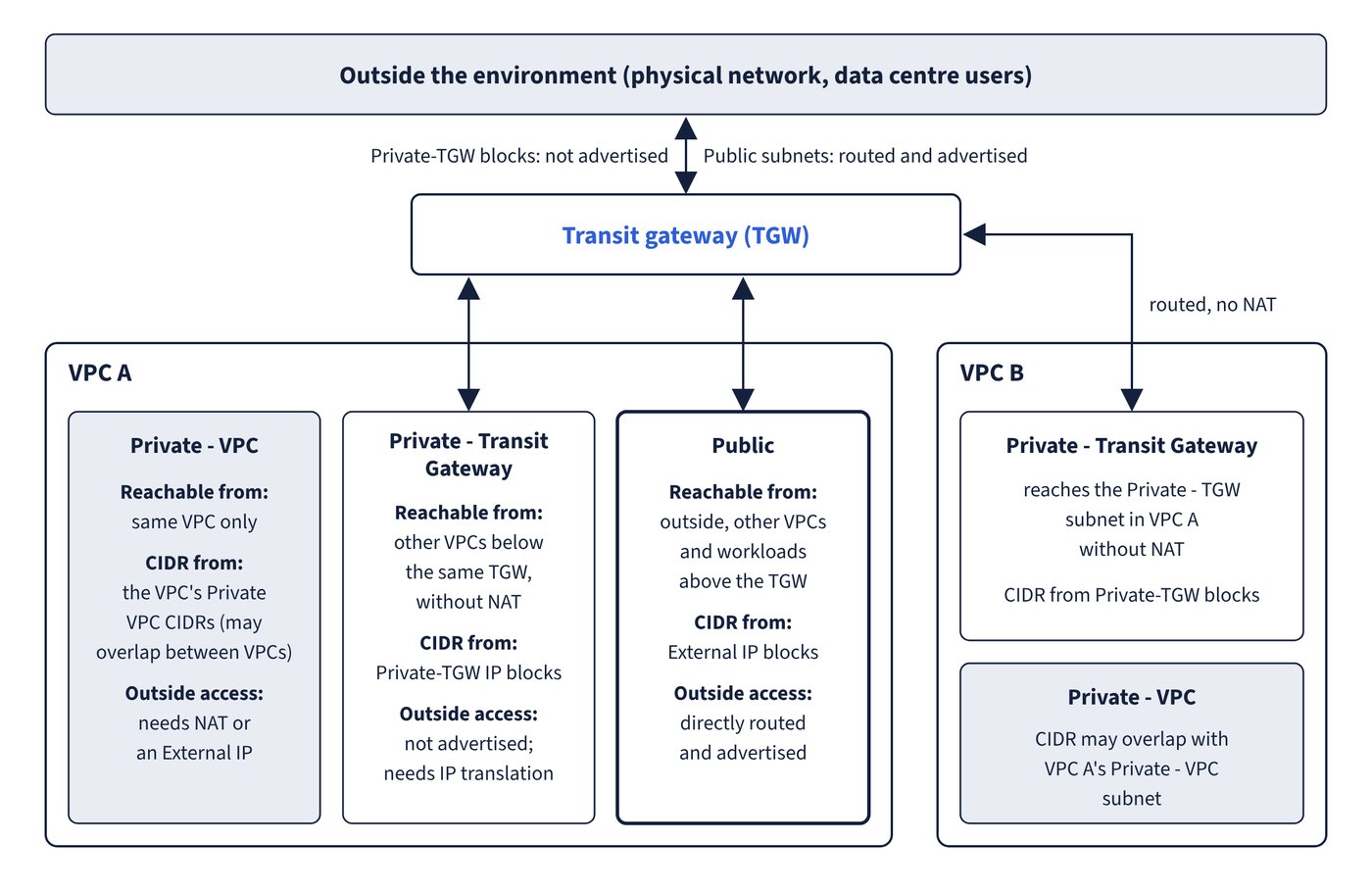
Three kinds of IP space
IP blocks in the VPC model fall into three groups with different reach.
| IP space | Defined where | Reach | Overlap allowed |
|---|---|---|---|
| Private VPC CIDRs | On the VPC itself | Local to the VPC; NAT needed to reach anything outside | Yes, between VPCs |
| Private - Transit Gateway IP blocks | Connectivity profile | Routed between VPCs on the same TGW without NAT; not advertised outside | No |
| External IP blocks | Connectivity profile (provider-managed) | Reachable from outside; used for public subnets, External IPs and SNAT | No |
- In NSX Manager, a plain IP address block is added under Networking > IP Management > IP Address Pools, on the IP Address Blocks tab, by entering a name and a CIDR.
- In VCF Automation, the provider administrator manages external IP blocks through IP spaces; the organization administrator can create private TGW IP blocks for the organization. The default private TGW block assigned by the provider cannot be edited directly while it is used in the organization’s default connectivity profile.
Subnet access modes (VCF 9.0 VPC model)
Subnet access modes in the VCF 9.0 VPC model are Private VPC, Private Transit Gateway and Public.
| Access mode | Reachable from | CIDR auto-allocated from | Outside access |
|---|---|---|---|
| Private - VPC | Other subnets in the same VPC only | The VPC’s Private VPC CIDRs | Needs NAT (Default Outbound NAT or SNAT) or an External IP |
| Private - Transit Gateway | Other VPCs below the same TGW, without NAT | Private-TGW IP blocks | Needs IP translation to be reachable from outside |
| Public | Outside the environment, other VPCs and workloads above the TGW | External IP blocks | Directly routed and advertised |
- When adding a subnet, the Gateway Connectivity toggle connects the subnet to the other subnets in the VPC.
- With Auto allocate Subnet CIDR from IP Blocks on, a subnet size is chosen and the CIDR comes from the block matching the access mode; with it off, the CIDR is typed in.
- The design library notes that in shared-gateway designs, NAT before the Tier-0 happens automatically for subnets in Private TGW or Private VPC mode, while Public mode bypasses NAT between the TGW and the Tier-0.
Isolated subnets in the NSX multi-tenancy VPC model
The NSX multi-tenancy chapters describe VPC subnet access modes as Private, Public and Isolated. An isolated subnet is not connected to the VPC’s implicit gateway: its workloads talk to each other but not to private or public subnets in the same VPC, and packets cannot leave the VPC. Isolated subnets support only manual IP assignment, so the VPC admin must type the CIDR.
- In that model, the system reserves four IP addresses in each subnet (network, gateway, broadcast and DHCP server). A subnet of size 32 therefore takes at most 28 workloads.
- Private subnet CIDRs cannot overlap inside one VPC, but they can overlap with subnets in another VPC.
- If DHCP is managed by NSX, the system allocates all available addresses to the DHCP pool. The UI cannot change this; a static pool size is set only through the NSX API.
PUT https://<nsx-mgr>/policy/api/v1/orgs/default/projects/<project-id>/vpcs/<vpc-id>/subnets/<subnet-id>/
{ "ipv4_subnet_size": 16, "access_mode": "Public", "resource_type": "VpcSubnet",
  "dhcp_config": { "enable_dhcp": true, "static_pool_config": { "ipv4_pool_size": 8 } } }
External IPs
External IPs give a VM on a private subnet outside reachability without making the subnet public. They are implemented as 1:1 NAT: an IP is taken from the External IP block and bound to the VM.
- They work with both centralized and distributed connections, which makes them the only way to expose private-subnet workloads in an Edge-less design.
- In the vSphere Client, select the VM and choose Actions > Assign External IP. Select the network adapter (only adapters on private VPC subnets without an External IP are listed), then auto-assign or pick an IP. In NSX Manager, External IPs are set on the VPC’s Additional Configurations page. A specific IP from an IP block is supplied through the NSX API.
Common trap: Using a Private - Transit Gateway subnet to publish a service to users in the data centre - Private-TGW blocks are routed only between VPCs and are not advertised. Outside users need a Public subnet or an External IP.