VCF 9.0 introduces a simplified workflow to set up network connectivity, available in both vCenter and NSX, that uses Broadcom-recommended defaults such as transport zones and uplink profiles. On a fresh installation the first choice in that workflow is the connectivity model. Figure 2.1 compares the two models side by side.
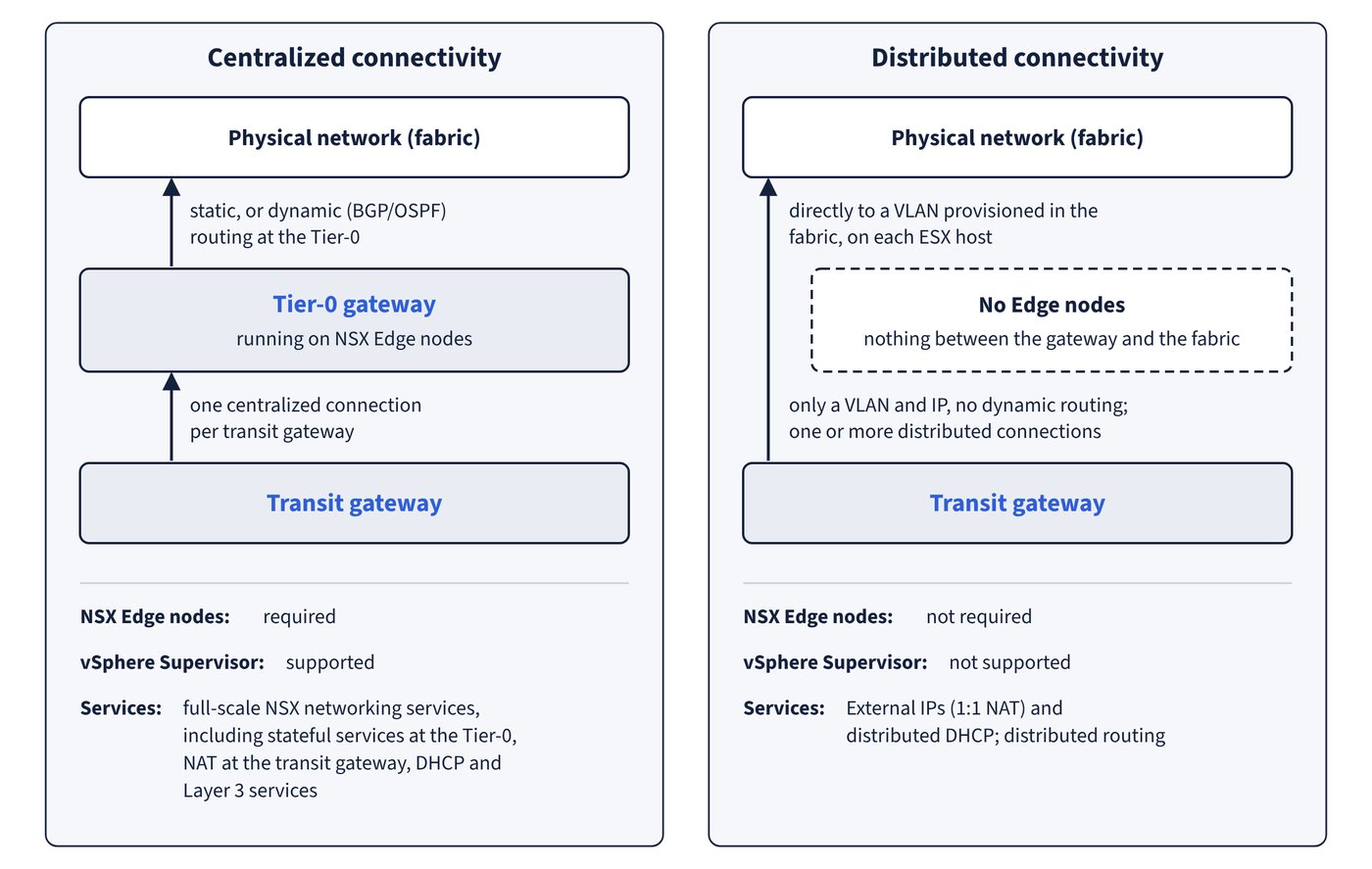
| Attribute | Centralized connectivity | Distributed connectivity |
|---|---|---|
| How the transit gateway reaches the fabric | Through a Tier-0 gateway running on NSX Edge nodes | Directly to a VLAN provisioned in the fabric, on each ESX host |
| NSX Edge nodes | Required | Not required |
| Routing with the fabric | Static, or dynamic (BGP/OSPF) at the Tier-0 | Minimal fabric configuration: only a VLAN and IP; no dynamic routing |
| Services | Full-scale NSX networking services: stateful services at the Tier-0, NAT at the transit gateway, DHCP, Layer 3 services | On-demand networking, distributed routing, External IPs (1:1 NAT) and distributed DHCP |
| External connections per transit gateway | One centralized connection | One or more distributed connections |
| vSphere Supervisor | Supported (and required for Supervisor) | Not supported |
| Design-library model | VPC with Full Services, VPC Scalable | VPC Getting Started |
Where the choice is made
- Workload domain wizard (VCF Operations). The “Configure Network Connectivity and VPC External IP Blocks” step offers Centralized Connectivity or Distributed Connectivity. Centralized is configured after the workload domain is created to make it VPC-ready. Distributed asks for the VLAN ID, the gateway CIDR (the same as the VLAN default gateway on the ToR), the external IP block and the Private - Transit Gateway IP block, and the domain is VPC-ready when creation finishes.
- vCenter. Networks > Network Connectivity > Configure Network Connectivity, for the vCenter of the workload domain.
- NSX Manager. System > Quick Start > Setup Network Connectivity > Configure NSX Networking, then Centralized Gateway or Distributed Gateway. The workflow requires the NSX administrator role.
The same workflow can manage Edge clusters created before an upgrade to 9.0: add or delete an Edge (delete only without dependent objects), set up a Tier-0 for an Edge cluster, reset Edge passwords and set VPC external IP blocks. Editing an Edge node still happens in NSX Manager.
Choosing
- Choose centralized when the environment needs NAT, stateful gateway firewalling, VPN, load balancing for Supervisor, dynamic routing with the fabric, or VCF Automation All Apps organizations.
- Choose distributed for the lightest footprint: no Edge lifecycle, no BGP, and VPC workloads exposed through public subnets or External IPs only.
- When the workload domain will host vSphere Supervisor, centralized connectivity is mandatory, and an NSX Edge cluster with an active-standby Tier-0 must be deployed after the workload domain to complete Supervisor activation, unless an existing NSX Manager already has a compatible Edge cluster.
Common trap: Choosing distributed connectivity for a workload domain that will enable vSphere Supervisor - Supervisor requires centralized connectivity, and its activation completes only once an Edge cluster with an active-standby Tier-0 exists.
Common trap: Choosing distributed connectivity to save Edge resources while still planning SNAT, DNAT or VPN - distributed connectivity offers only External IPs (1:1 NAT) and distributed DHCP; NAT rules, centralized firewalling and VPN all need Edge nodes and a centralized connection.