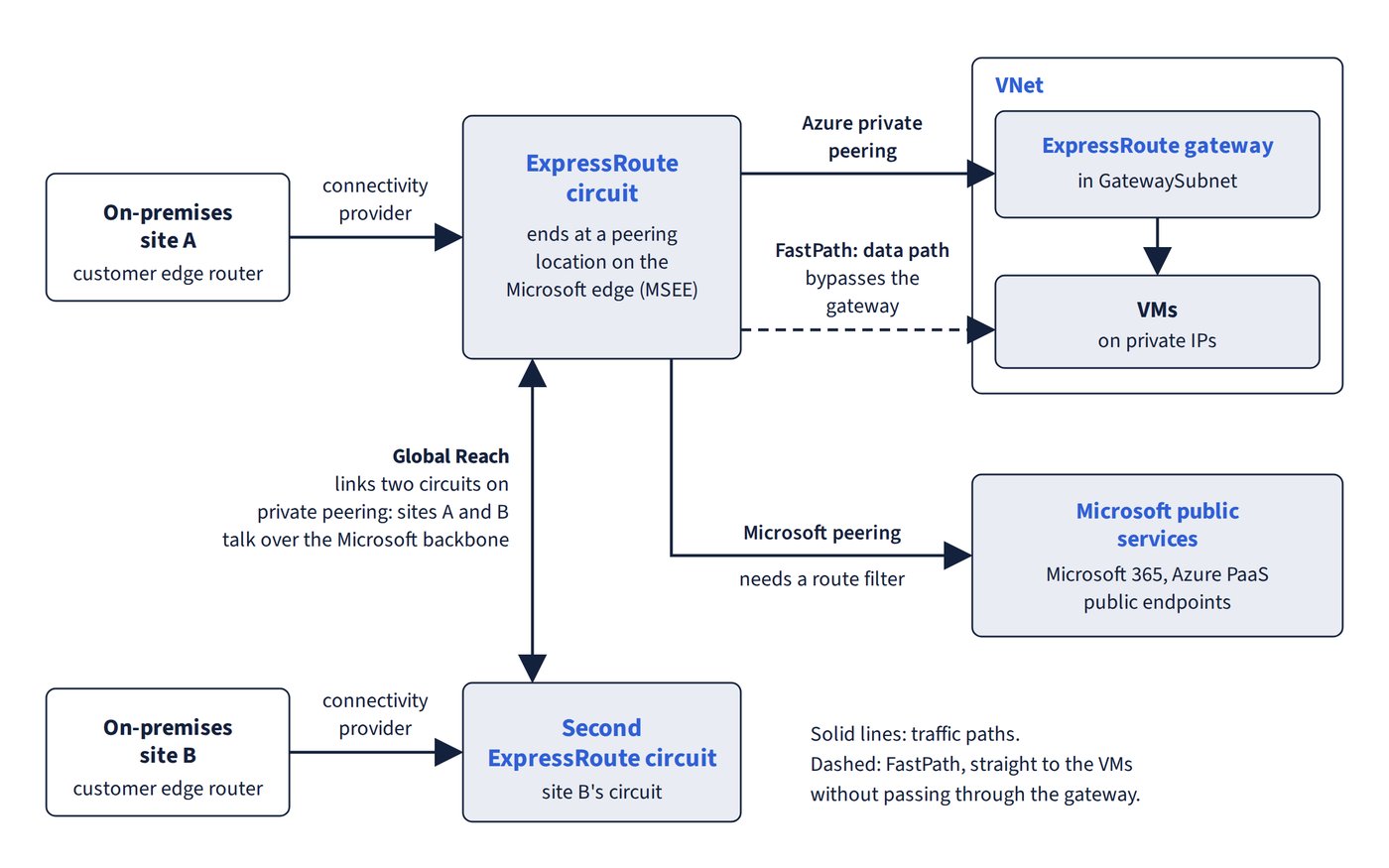
These three features are easy to confuse because all of them sound like “faster” or “bigger” ExpressRoute. Each solves a different problem, and each has a scenario it does not address. Figure 7.1 shows where each peering leads and where Global Reach and FastPath fit on the circuit.
| Feature | What it does | Not for |
|---|---|---|
| Global Reach | Links two ExpressRoute circuits so on-premises sites exchange traffic over the Microsoft backbone; configured on Azure private peering | Not supported on ExpressRoute Local |
| FastPath | Sends on-premises traffic straight to VMs, bypassing the ExpressRoute gateway in the data path | Site-to-site links; faster failover |
| ExpressRoute Direct | Physical 10/100 Gbps port offering | Linking sites to each other |
- Global Reach between circuits in the same geopolitical region needs no Premium upgrade; Premium is only for other geopolitical regions or higher route limits.
- FastPath needs Ultra Performance, ErGw3AZ, or ErGwScale with at least 10 scale units; Standard/ErGw1AZ and High Performance/ErGw2AZ don’t support it.
- FastPath to same-region peered VNets applies to ExpressRoute Direct circuits.