Azure takes a fixed number of addresses from every subnet, so the usable count is always smaller than the raw prefix size, and that shapes every sizing decision.
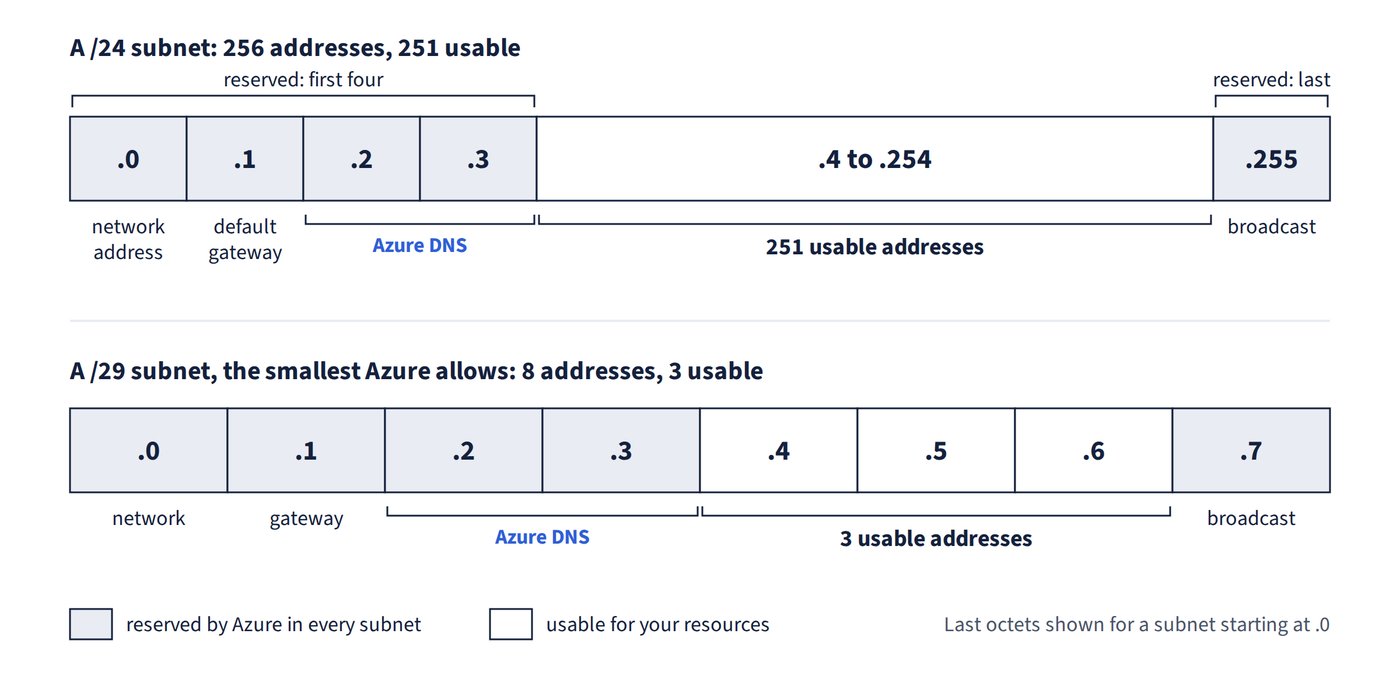
- Azure reserves 5 addresses in every subnet (Azure reserved addresses): the network address, the default gateway, two addresses that map to Azure DNS, and the broadcast address. Figure 1.1 shows where the five reserved addresses sit in a /24 and in a /29.
- The smallest supported IPv4 subnet is /29 (3 usable addresses); /30 and /31 aren’t supported.
| Prefix | Addresses | Usable in Azure |
|---|---|---|
| /29 | 8 | 3 |
| /28 | 16 | 11 |
| /27 (255.255.255.224) | 32 | 27 |
| /26 | 64 | 59 |
| /25 | 128 | 123 |
| /24 | 256 | 251 |
| /23 | 512 | 507 |
- A /24 can be split into at most 32 /29 subnets. No Azure subnet size leaves exactly 7 usable addresses.
Common trap: Splitting a /24 into 128 subnets with 7 usable addresses each - that would mean /31 subnets, which Azure doesn’t support, and a /31 has only 2 addresses anyway. The most you can get from a /24 is 32 /29s with 3 usable addresses each.
Common trap: Choosing a /25 for 507 or 510 hosts - a /25 gives only 123 usable addresses; 507 hosts need a /23.
Design decisions when dividing a /24
Because every subnet costs 5 addresses, the fewer subnets you create, the more addresses you keep for workloads.
- To maximise usable IPs, use the fewest subnets: two /25s give 246 usable addresses, while four /26s give only 236.
- A /24 holding a gateway plus VMs: use two /25s. A /25 meets the /27 minimum recommended for the GatewaySubnet and loses fewer addresses to reservations.
- A /24 holding Azure Bastion plus VMs: allocate a /26 AzureBastionSubnet, then a /25 (123) plus a /26 (59) for VMs, giving 182 usable VM addresses; three /26 VM subnets would give only 177.
- 150 VMs in one VNet need two /25 subnets (246 usable).
Common trap: Splitting the /24 into /26s when it must hold a gateway plus VMs - two /25s lose fewer addresses to Azure’s reservations.
Common trap: Making a /26 the larger VM subnet alongside Bastion to reach 182 addresses - 182 usable addresses need a /25 as the larger VM subnet (123 + 59).