The AI Search endpoint type is the first configuration lever, and it is set when the endpoint is created. It fixes capacity, latency, sync behaviour and even the syntax of filters.
| Factor | Standard endpoint | Storage-optimized endpoint |
|---|---|---|
| Choose when | Latency is critical and the index is well under 320M vectors | 10M+ vectors, some extra latency is acceptable, better cost per vector matters |
| Endpoint capacity at 768 dimensions | About 320M vectors (Delta Sync index) | About 1B vectors |
| One vector search unit (VSU) covers | 2M vectors at 768 dimensions | 64M vectors at 768 dimensions |
| Reference latency | 20-50 ms | 300-500 ms |
| Reference throughput | 30-200+ QPS | 30-50 QPS |
| Cost per vector | Higher | Up to 7x cheaper |
| Indexing speed | Baseline | 10-20x faster |
| Continuous sync | Supported | Not supported |
| Incremental sync | Yes; only changed data is processed | Partial; every sync rebuilds portions of the index |
| Target QPS (high QPS) | Supported | Not supported |
| Filter syntax | Python dictionary | SQL-like string |
| Embedding dimension rule | Up to 4096 per index | Up to 4096 and divisible by 16 |
| Change data feed on the source | Required | Not listed as a requirement |
| FedRAMP compliant workspaces | No such limitation stated | Not supported |
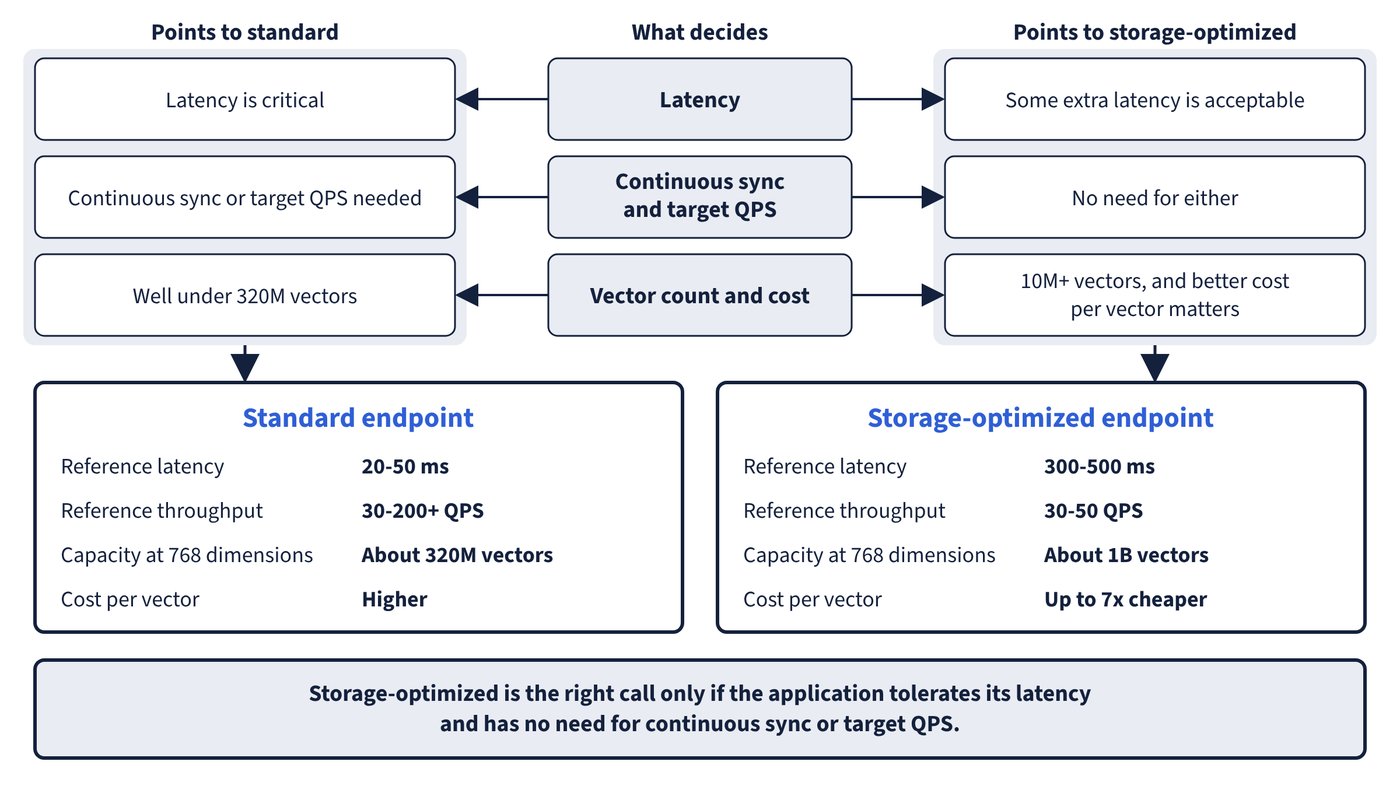
Capacity scales with dimension. A standard endpoint holds about 320M vectors at 768 dimensions, 160M at 1536 and 80M at 3072, roughly linearly. Pricing follows the same equivalence: 1M vectors at 1536 dimensions counts as one standard unit, the same as 2M at 768. A larger embedding model therefore consumes capacity and budget, not only query time. Figure 7.1 sets out what decides between the two types.
Direct Vector Access indexes have a much lower ceiling on standard endpoints: about 2M embeddings at 768 dimensions, against about 320M for Delta Sync. Bulk upsert and delete requests are also limited to 10 MB each.
A few limits apply whichever type is chosen:
- 500 endpoints per workspace and 50 indexes per endpoint.
- 50 columns and 50 metadata fields per index.
- 100 KB per row for a Delta Sync index, and 32,764 bytes for the embedding source column.
Common trap: Picking storage-optimized for every large index because it is cheaper - it is the right call only if the application tolerates its latency and has no need for continuous sync or target QPS. A search bar with a sub-100 ms target rules it out at any size.
Common trap: Starting with a small sample table and expecting the index to grow later - index capacity is provisioned from the source table’s size at creation, so a small start can lead to capacity-exhausted errors. Size the source table to the expected volume before creating the index.