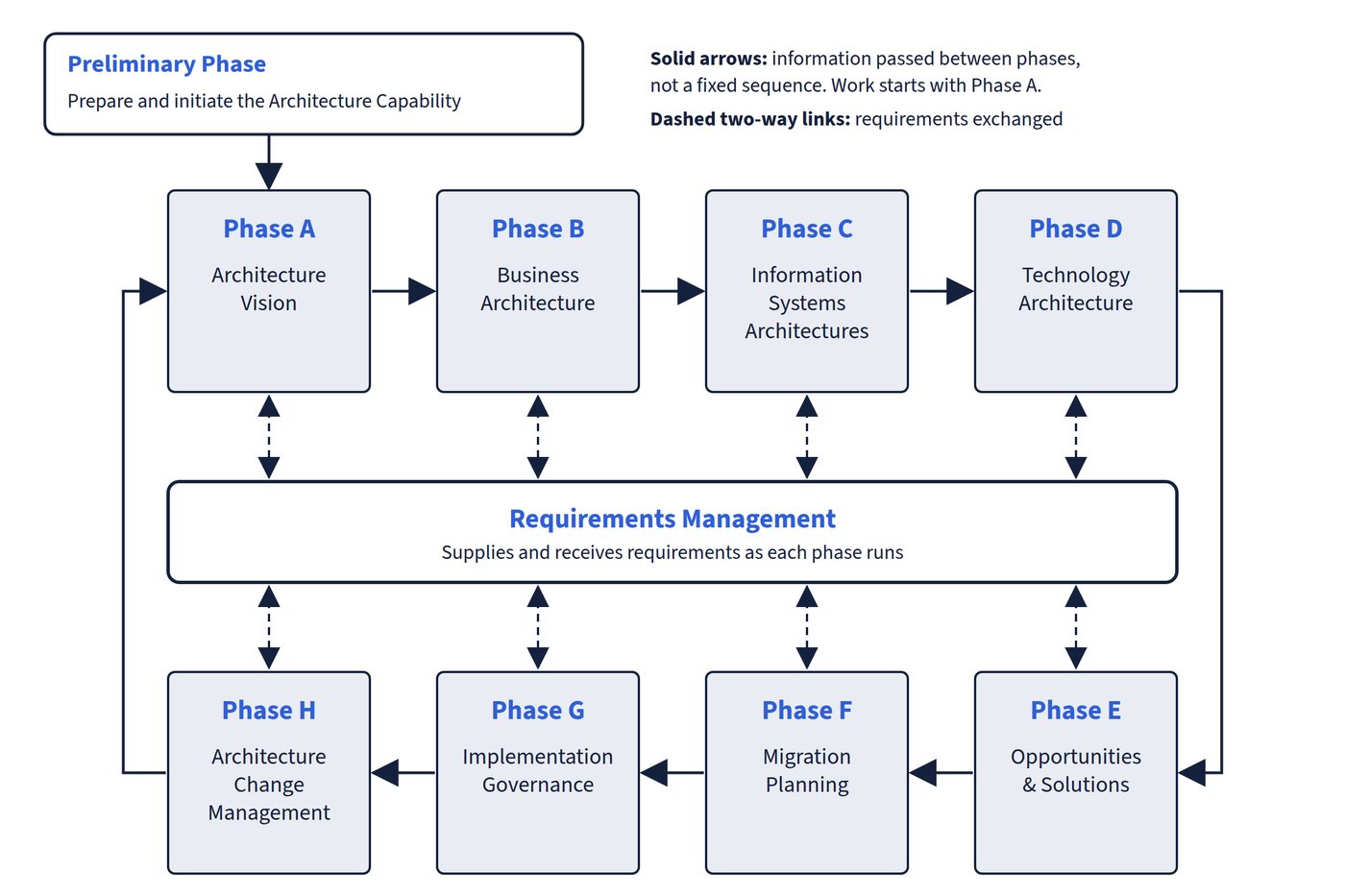
The ADM has a Preliminary Phase, eight lettered phases from A to H, and Requirements Management at the centre. The table gives each phase’s purpose in one line and the essential output that the Practitioners’ Approach Series Guide (G186) associates with it.
| Phase | Purpose in brief | Essential output (G186) |
|---|---|---|
| Preliminary | Prepare and initiate the Architecture Capability, customise the TOGAF framework and define Architecture Principles | - |
| A: Architecture Vision | Set the scope, identify stakeholders, create the Architecture Vision and obtain approval to proceed | Enough documentation to obtain permission to proceed with developing a Target Architecture |
| B: Business Architecture | Develop the Business Architecture that supports the agreed Vision | A set of stakeholder-approved domain architectures, with gaps and the work to close them understood |
| C: Information Systems Architectures | Develop the Data and Application Architectures that support the Vision | As for B |
| D: Technology Architecture | Develop the Technology Architecture that supports the Vision | As for B |
| E: Opportunities & Solutions | Carry out initial implementation planning and identify delivery vehicles | A set of work packages addressing the gaps, with their value, effort and dependencies |
| F: Migration Planning | Plan the move from Baseline to Target by finalising a detailed Implementation and Migration Plan | An approved set of projects, each with objectives, constraints, resources and start and finish dates |
| G: Implementation Governance | Provide architectural oversight of the implementation | Completion of the projects that implement the changes |
| H: Architecture Change Management | Establish procedures for managing change to the new architecture | Direction to proceed with developing a new Target that addresses shortfalls against stakeholder preferences |
| Requirements Management | Manage architecture requirements throughout the ADM | - |
Chapter 5 covers the Preliminary Phase and Phase A, Chapter 6 covers Phases B, C and D, Chapter 7 covers Phases E and F, and Chapter 8 covers Phases G, H and Requirements Management. Figure 4.1 shows the phases and their links to Requirements Management.