Abstraction lets architects discuss a complex system without drowning in detail. The Standard defines four levels, each answering a different question.
Abstraction means producing simplified views of a system-of-interest so that people can discuss it and make decisions about it. The views are layered, from the most general down to the most detailed. The four levels apply across all four domains, not just one. Figure 2.1 shows the four levels applied across the four domains.
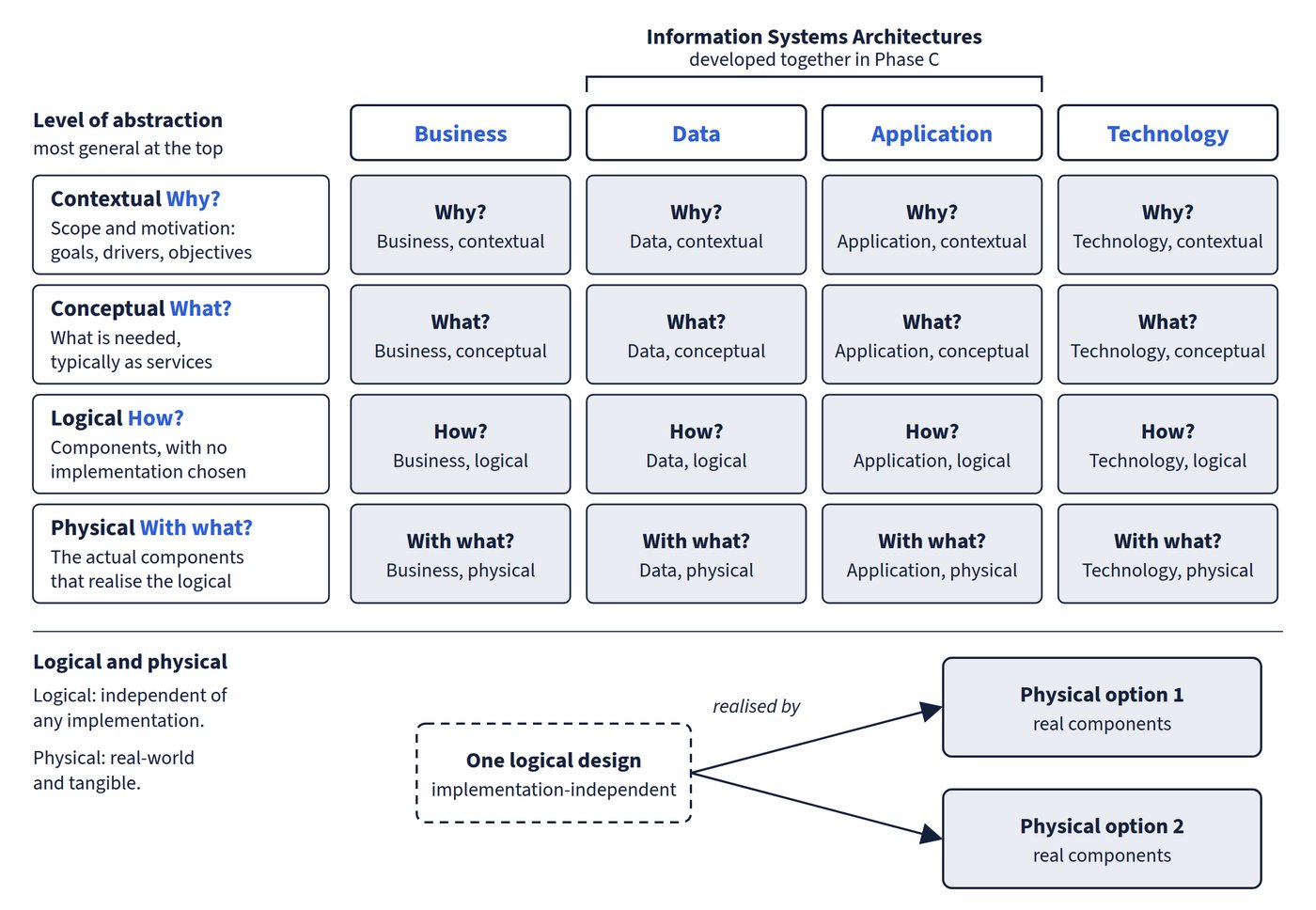
| Level | Question it answers | Focus |
|---|---|---|
| Contextual | Why? | The environment, scope and motivation: goals, drivers and objectives |
| Conceptual | What? | Breaking requirements down into what is needed, typically modelled as services; also called service or behaviour abstraction |
| Logical | How? | Components that group the services together without committing to an implementation; several logical alternatives may exist |
| Physical | With what? | The actual components that realise the logical ones; several physical alternatives may exist |
Logical and physical
The distinction between the last two levels comes up repeatedly. Logical means independent of any implementation; physical means real-world and tangible. A logical architecture is realised by a physical one, and the same logical design can be realised in more than one physical way. The same idea underpins the difference between Architecture Building Blocks (logical, supplier-independent) and Solution Building Blocks (physical, implementation-specific), introduced later in this chapter.
Common trap: The why/what/how/with-what questions are borrowed from the Zachman framework and mean the same there - the Standard is explicit that this usage has nothing to do with Zachman’s.