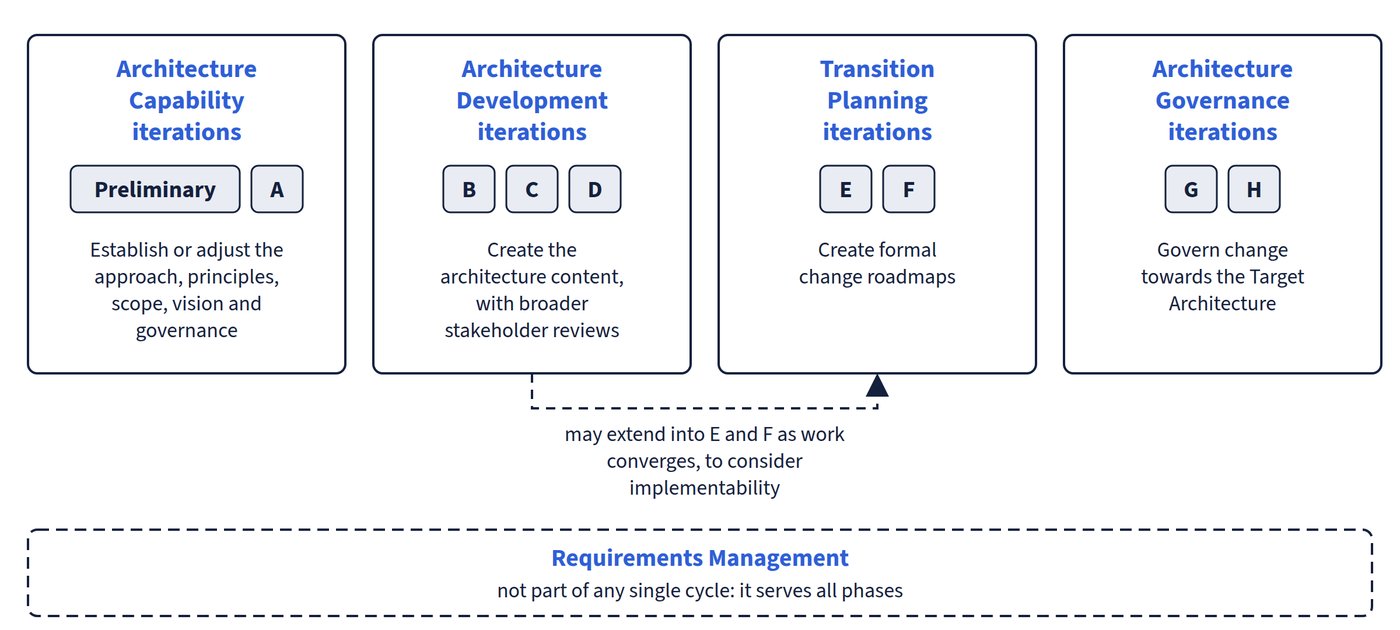
Architecture Capability, Architecture Development, Transition Planning and Architecture Governance iterations, and the phases each one spans.
From Ultra Transcenders OGEA-101 by Tony Rough (publishing soon)
The Standard groups the ADM phases into four iteration cycles, each with a distinct purpose. These groupings show which phases tend to be iterated together.
| Iteration cycle | Phases | Purpose |
|---|---|---|
| Architecture Capability iterations | Preliminary and A | Establish or adjust the approach, principles, scope, vision and governance |
| Architecture Development iterations | B, C and D | Create the architecture content, with broader stakeholder reviews; may extend into E and F as work converges, to consider implementability |
| Transition Planning iterations | E and F | Create formal change roadmaps |
| Architecture Governance iterations | G and H | Govern change towards the Target Architecture |
Requirements Management is not part of any single cycle; it serves all phases, as described in Chapter 8, Phases G, H and Requirements Management. Figure 12.1 shows the four cycles and where Requirements Management sits.
Common trap: Phase A belongs with the development phases B, C and D - in the four iteration cycles, Phase A is paired with the Preliminary Phase in Architecture Capability iterations.
This note is one section of Ultra Transcenders OGEA-101: Enterprise Architecture Foundation, an independent study guide that explains every learning unit the exam covers, topic by topic, with comparison tables, diagrams and the common traps, plus a glossary linked to the TOGAF Standard.
Publishing soon on Amazon in Kindle and paperback editions.
About the book · OGEA-101 terms in the glossary · All OGEA-101 study notes
What the Business, Data, Application and Technology domains each describe, and which subjects cut across all four.
The contextual, conceptual, logical and physical levels, the question each answers, and the difference between logical and physical.
Why the Enterprise Continuum is a classification scheme rather than a place, and what it does for communication and re-use.
The Preliminary Phase, Phases A to H and Requirements Management, each with its purpose and essential output.
How to set Baseline Architecture Building Blocks against Target ones to see what is included, what is new and what is eliminated.
What an Architecture Board is accountable for, who should sponsor it and how large it should be.
How stakeholders' concerns are framed by viewpoints and addressed by views, and why a view and a viewpoint are not the same thing.