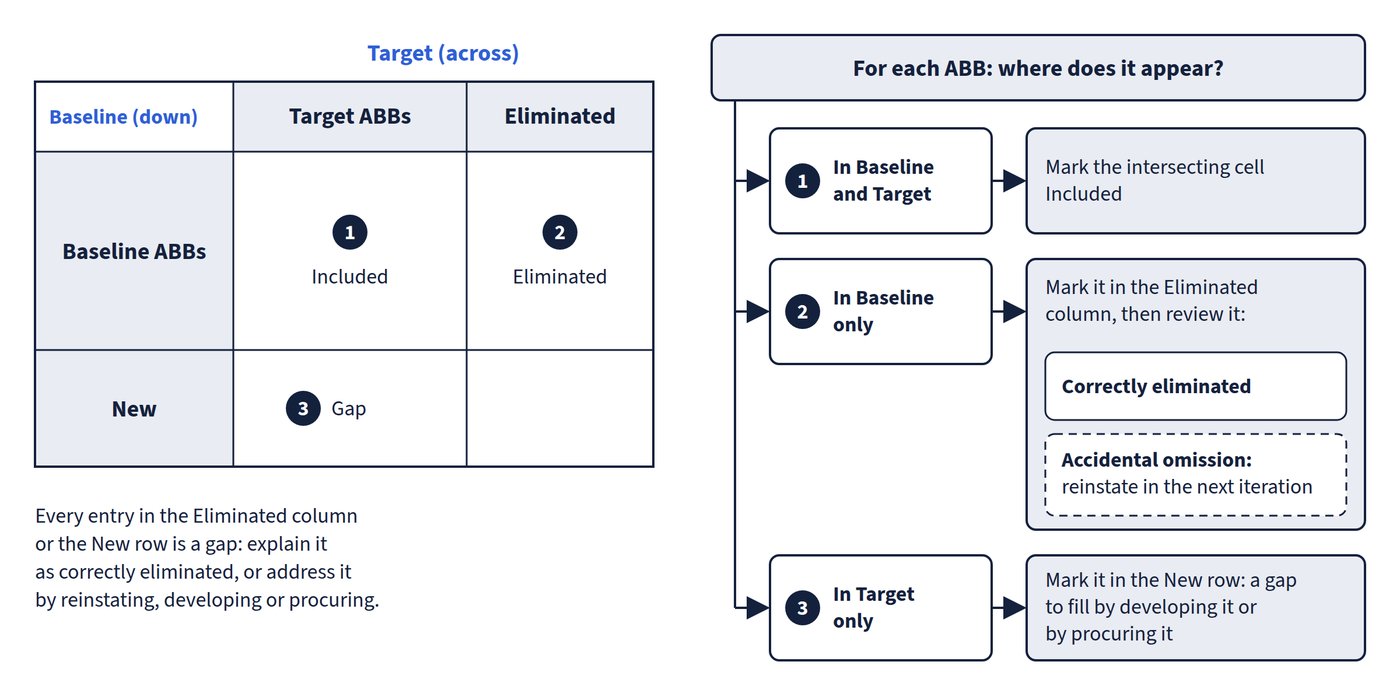
The Standard’s gap analysis technique uses a simple matrix that compares Architecture Building Blocks (ABBs) in the two states. Its own worked example draws on the Network Services of the Technical Reference Model. Figure 10.1 shows the matrix layout and how each building block is classified.
The steps are:
- Draw a matrix with the Baseline ABBs down the vertical axis and the Target ABBs across the horizontal axis.
- Add a final row labelled “New” to the Baseline axis, and a final column labelled “Eliminated” to the Target axis.
- Where an ABB appears in both Baseline and Target, mark the intersecting cell “Included”.
- Where a Baseline ABB has no counterpart in the Target, review it. If it has been correctly eliminated, mark it in the Eliminated column. If it was left out by accident, it has to be reinstated in the next iteration of the design; it is also marked in the Eliminated column.
- Where a Target ABB has no counterpart in the Baseline, mark it in the “New” row as a gap to be filled, either by developing it or by procuring it.
An illustrative matrix
The matrix below uses generic building block names purely to show the layout. Building blocks A and C exist in both states, B exists only in the Baseline, and D exists only in the Target.
| Baseline (down) / Target (across) | ABB A | ABB C | ABB D | Eliminated |
|---|---|---|---|---|
| ABB A | Included | |||
| ABB B | Eliminated: review whether intentional or an accidental omission | |||
| ABB C | Included | |||
| New | Gap: develop or procure |
Common trap: The Target goes down the side and the Baseline across the top, with “Eliminated” as a row - the Baseline is on the vertical axis with the “New” row added to it, and the Target is on the horizontal axis with the “Eliminated” column added to it.