Remote datastore sharing lets vSAN clusters share their datastores with other clusters. A cluster that provides a datastore acts as a server; a cluster that mounts it acts as a client.
- A vSAN HCI cluster provides both compute and storage. It can share its datastore across data centres and vCenter instances, and it can mount datastores from other vSAN HCI clusters.
- A vSAN storage cluster is a deployment model based on vSAN ESA. It provides storage resources, not compute resources. Its datastore can be mounted by compute clusters or vSAN HCI clusters, across data centres and vCenter instances.
- A compute cluster is a vSphere cluster with a small vSAN element that lets it mount a remote datastore hosted on a vSAN storage cluster. Its ESX hosts have no local vSAN storage, and the hosts only need to comply with the Broadcom Compatibility Guide for vSphere, not for vSAN.
- A client cluster is any cluster (HCI or compute) that mounts a remote datastore. The VCF design library uses “vSAN client cluster” and “vSAN compute cluster” for the consumer side of a storage cluster.
Mounting a remote datastore is a cluster-wide configuration: once mounted, it is available to all hosts in the client cluster. When a new virtual machine is provisioned, the remote datastore can be selected like any other, with any compatible storage policy configured for that datastore. Figure 3.1 shows the three cluster roles and the mounts between them.
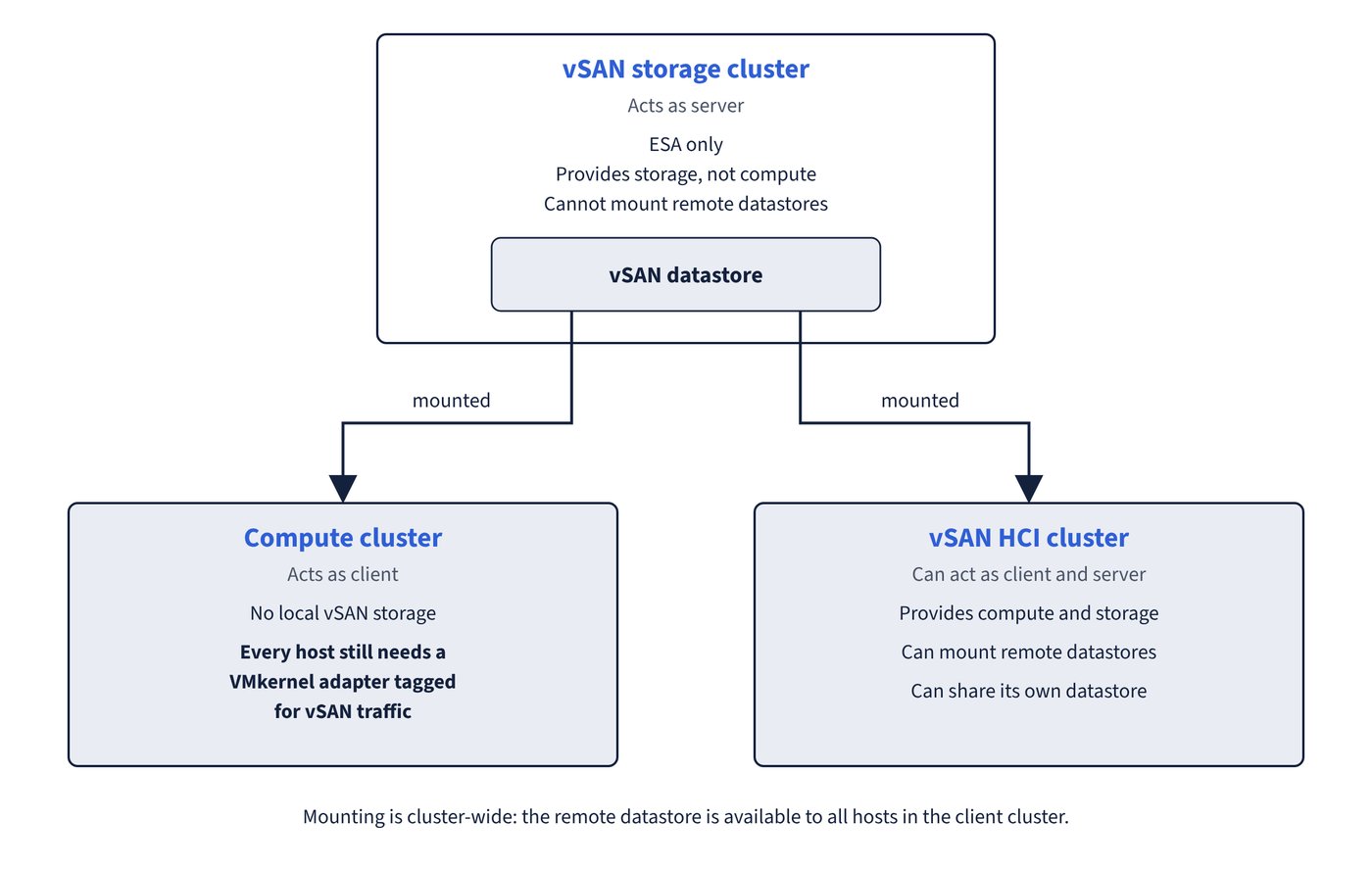
| Attribute | vSAN HCI cluster | vSAN storage cluster | Compute cluster |
|---|---|---|---|
| Provides compute for workloads | Yes | Not recommended (storage server only) | Yes |
| Provides a vSAN datastore | Yes | Yes | No |
| Can mount remote datastores | Yes | No (acts as server, not client) | Yes |
| Architecture | ESA or OSA | ESA only | No local vSAN storage |
| vSAN Ready Nodes required | Yes | Yes, certified for vSAN storage clusters | No |
| Data management features (dedupe, encryption and so on) on the cluster | Yes | Yes | None can be configured |
Compute cluster hosts still need vSAN networking. The rules are strict: vSAN networking must be configured on every host, no vSAN storage-eligible devices can be present on the hosts, and no data management features can be configured on the cluster.
Common trap: Assuming a compute cluster needs no vSAN configuration because it has no disks - every host in a compute cluster still needs a VMkernel adapter tagged for vSAN traffic, because that is how it reaches the remote datastore.
Common trap: Planning to convert an existing vSAN HCI cluster into a vSAN storage cluster later - a storage cluster can only be configured at cluster creation. Converting either way requires deactivating vSAN and reconfiguring the cluster.