Start by working out which path applies, because each has its own order of work and its own evidence. The starting state decides it, not the outcome anyone would prefer. Figure 3.1 shows each path, and the order a VVF convergence follows.
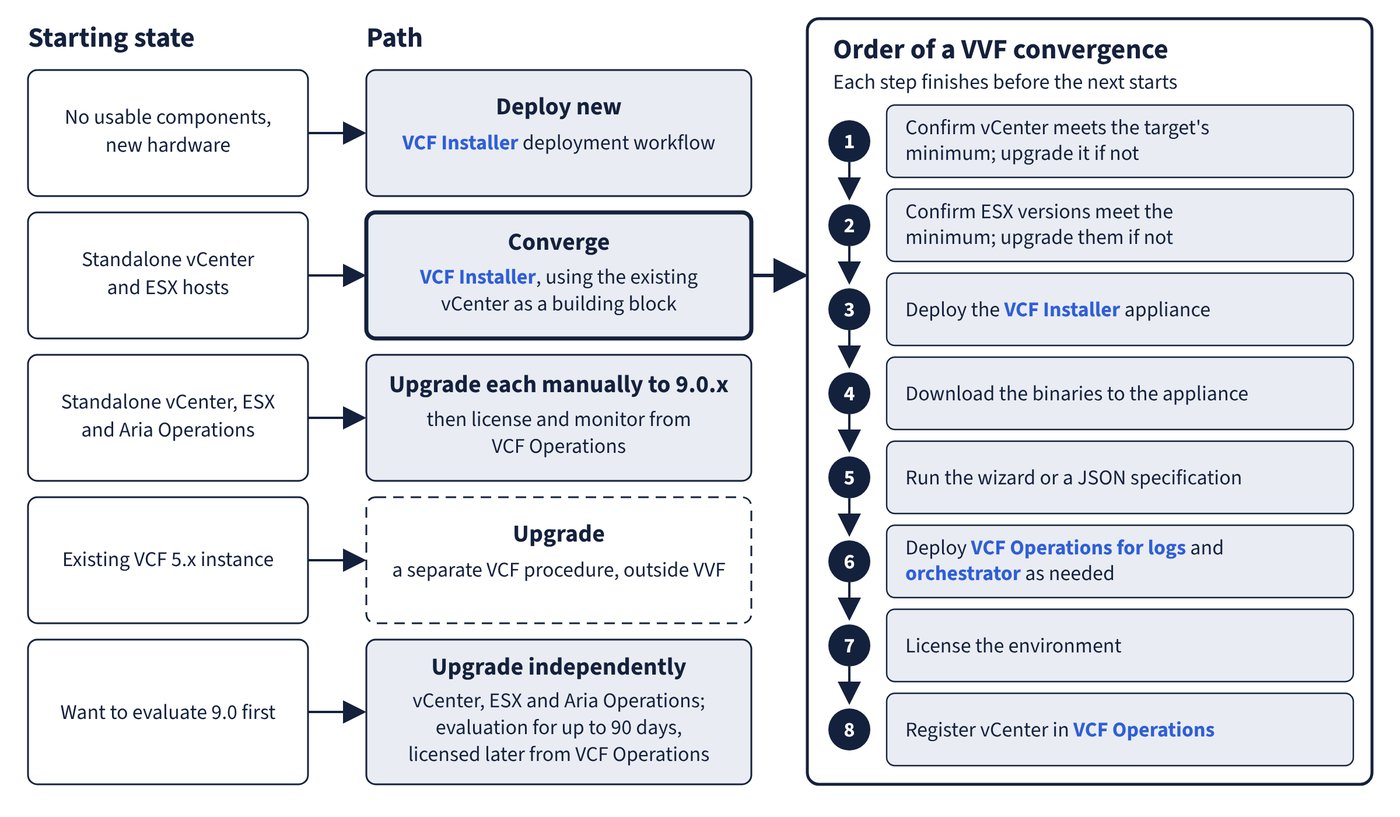
| Starting state | Path | What runs it |
|---|---|---|
| No usable components, new hardware | Deploy new | VCF Installer deployment workflow (see “Deploying VVF with the VCF Installer”) |
| Standalone vCenter and ESX hosts | Converge | VCF Installer, using the existing vCenter as a building block |
| Standalone vCenter, ESX and Aria Operations | Upgrade each manually to 9.0.x, then license and monitor from VCF Operations | Component upgrades, not the installer’s convergence workflow |
| Existing VCF 5.x instance | Upgrade | A separate VCF procedure, outside VVF |
| Want to evaluate 9.0 first | Upgrade vCenter, ESX and Aria Operations independently | Evaluation for up to 90 days, licensed later from VCF Operations |
VCF Installer replaces the Cloud Builder appliance in 9.0. Other names changed with the release too: ESXi is now ESX, VMware Aria Operations is VCF Operations, and VMware Aria Operations for Logs is VCF Operations for logs.
The scope of a VVF convergence is small compared with VCF, and that scope is the first filter for any fix you read about. The installer’s scope table lists these appliances for vSphere Foundation:
| Component | Deployed for VVF by the installer | Deployed for VCF |
|---|---|---|
| vCenter | Yes (or reused when converging) | Yes |
| VCF Operations primary node | Yes | Yes |
| VCF Operations replica and data nodes | No | High availability model only |
| VCF Operations collector (cloud proxy) | No | Yes |
| VCF Operations fleet management | No | Yes |
| NSX | No | Yes |
| VCF Automation | No | Yes |
| SDDC Manager | No | Yes |
The required binaries follow the same line. For vSphere Foundation they are VCF Operations and vCenter only, and binaries can be skipped where components are being reused.
Some products have no upgrade path into 9.0, and that catches people planning a move from the 8.x estate. Aria Operations for Logs has no upgrade path, so VCF Operations for logs 9.0 is a redeployment. Afterwards the remaining components are deployed by hand: VCF Operations for logs and, if wanted, VCF Operations orchestrator.
Common trap: Assuming every VCF convergence step applies to VVF - the VCF scenario pages add NSX, fleet management and SDDC Manager work. The VVF procedure is its own page, and its installer workflow deploys only VCF Operations against the existing vCenter.
Common trap: Running the installer because Aria Operations already exists - with an existing vCenter, ESX and Aria Operations, the VVF page says to upgrade each manually to 9.0.x and then use VCF Operations to license and monitor the platform.