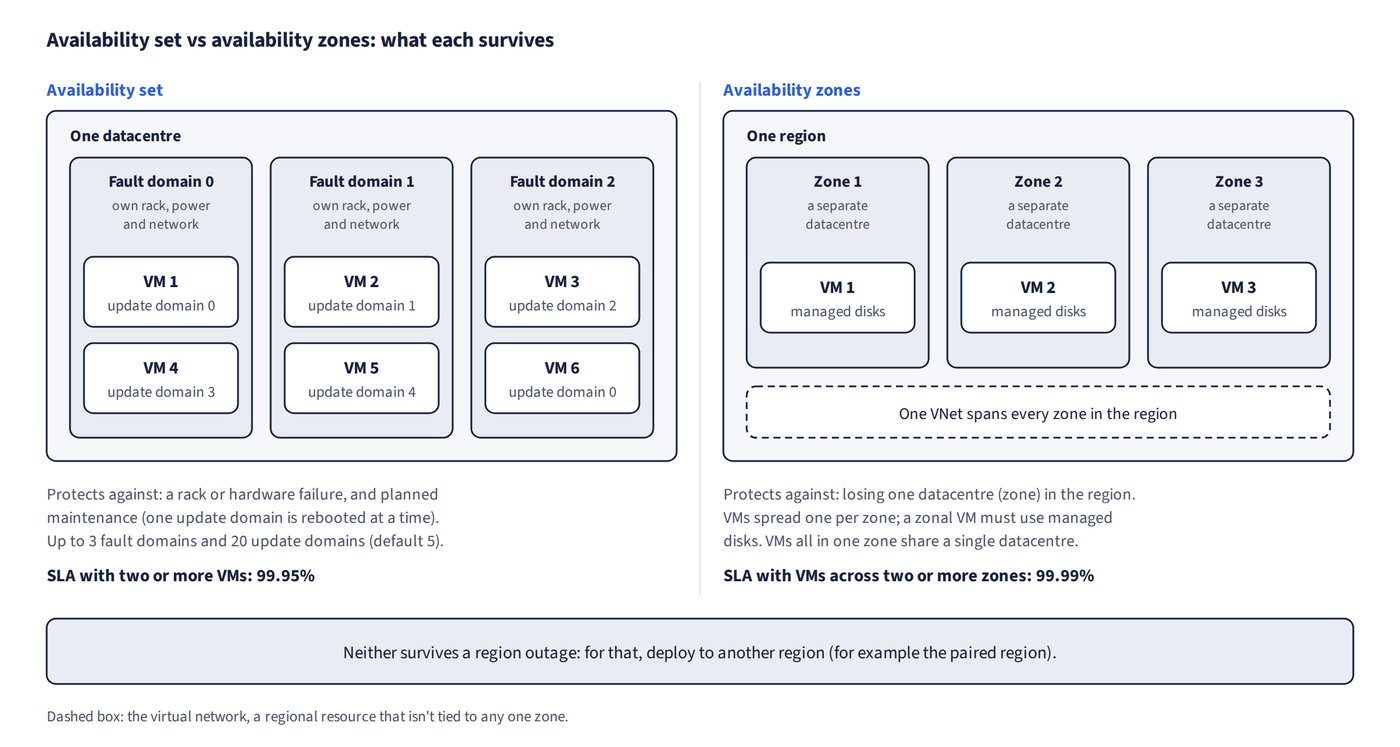
Availability options decide what kind of failure a group of VMs can survive. An availability set spreads VMs within one datacentre; availability zones spread them across datacentres in a region; neither protects against losing the whole region.
| Availability set | Availability zones | |
|---|---|---|
| Protects against | Rack/hardware failure and planned maintenance in one datacentre | Loss of one datacentre (zone) in a region |
| Mechanism | Fault domains (max 3, some regions 2) and update domains (max 20, default 5) | VMs spread one per zone |
| Region outage | No | No; use another region (for example the paired region) |
With two or more VMs, an availability set qualifies for a 99.95% VM SLA, while VMs spread across two or more availability zones qualify for 99.99%. (See Figure 8.1.)
Update domains and fault domains
- Update domains cover planned maintenance. Azure reboots one update domain at a time, so two VMs need at least two update domains; with a single update domain, every VM can reboot together.
- Fault domains cover unplanned power, network or rack failures.
- To maximise availability, set
platformFaultDomainCount = 3andplatformUpdateDomainCount = 20. - Worked examples: 14 VMs across 10 update domains puts at most 2 VMs down during maintenance, and a rack failure with 2 fault domains takes out 7 VMs. With 10 VMs across 10 update domains, at least 9 stay up.
- Scale sets use up to five update domains per placement group and can’t be set to 10 like an availability set.
Availability zones
- A VNet is regional and spans every zone, so zonal VMs can share one VNet. VMs that are all in one zone share a single datacentre.
- Zonal VM requirements: managed disks (unmanaged disks aren’t supported), with Availability options set to “Availability zone” and a zone picked. Choosing “No infrastructure redundancy required”, or an availability set, rules out a zone. The OS disk type, image and size usually don’t matter.
Proximity placement groups
A proximity placement group (PPG) keeps resources physically close for low latency, and it is regional: a VM or scale set can use only a PPG in its own region. The resource group’s location doesn’t matter.