Azure Storage always keeps multiple copies of your data; the redundancy option decides where those copies live and therefore which failures the data survives. The trade-off is cost against the size of the failure you’re protecting against.
| Option | Copies and replication | Survives |
|---|---|---|
| LRS | 3 synchronous copies in one datacentre in the primary region; cheapest | Disk or rack failure, not a datacentre outage |
| ZRS | Synchronous across 3 availability zones in the primary region | Loss of one zone or datacentre |
| GRS / RA-GRS | LRS in the primary region + asynchronous copy to the fixed paired region (for example North Europe ↔︎ West Europe) | Regional outage |
| GZRS / RA-GZRS | ZRS in the primary region + asynchronous copy to the paired region | Zone and regional outage |
- GRS can’t target a region of your choosing; the secondary is always the paired region. Use object replication when you need a copy in a specific region.
- Customer-managed account failover to the secondary region is started from the Redundancy blade (formerly Geo-replication) of a GRS, RA-GRS, GZRS or RA-GZRS account.
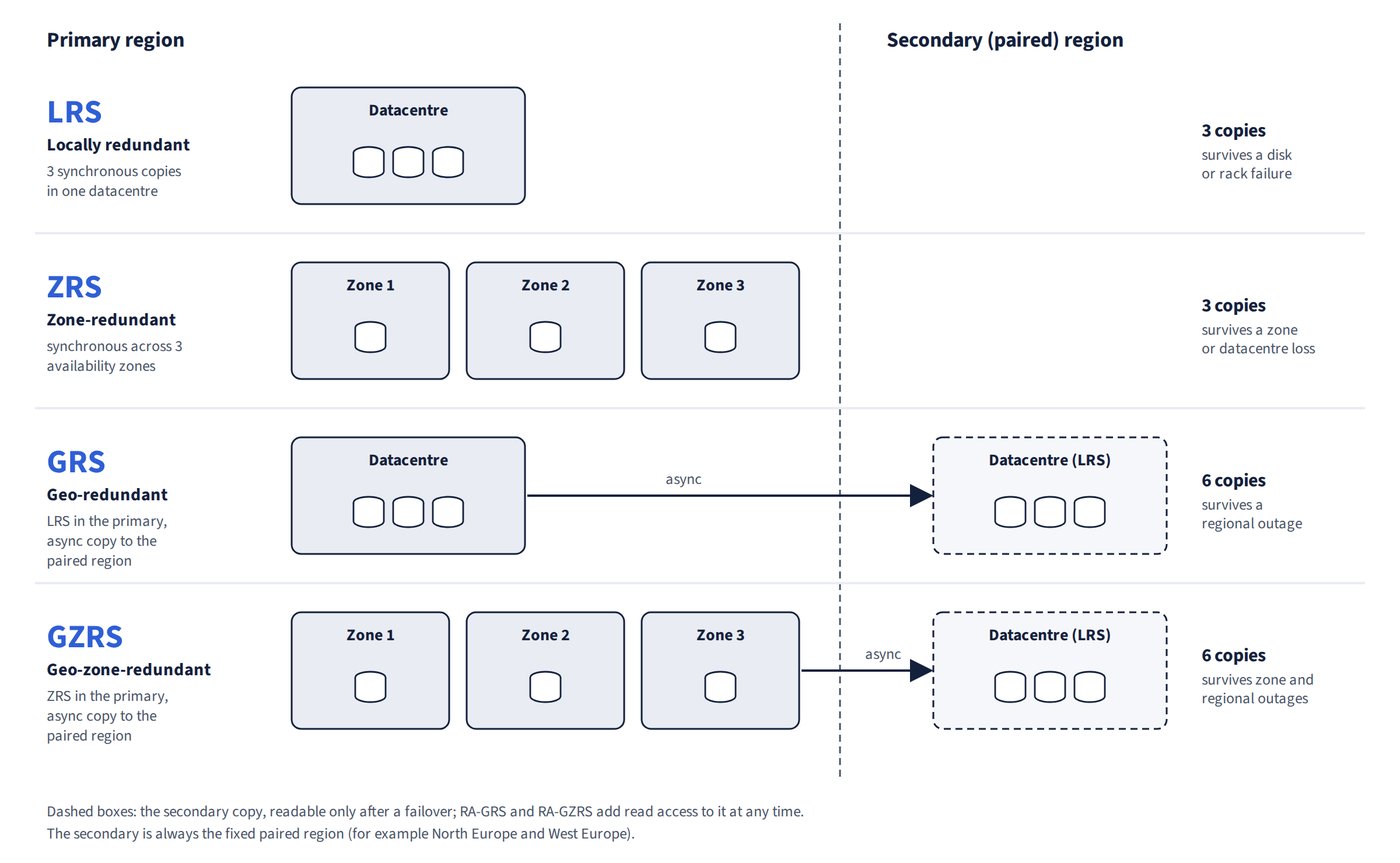
With GRS and GZRS the secondary region keeps three more synchronous (LRS) copies, six copies in all, and that data can be read only after a failover; RA-GRS and RA-GZRS add read access to the secondary region at any time. (See Figure 4.1.)
Which accounts support ZRS and Archive
- ZRS is supported on Standard GPv2, premium BlockBlobStorage and premium FileStorage.
- Standard GPv2 can be converted to ZRS where the region supports it: historically by a live migration requested through support; today by a customer-initiated conversion from the account’s Redundancy page, PowerShell or the CLI. GPv1 must be upgraded to GPv2 first; BlobStorage doesn’t support ZRS; Premium StorageV2 (page blobs) isn’t eligible.
- The Archive tier isn’t supported on ZRS, GZRS, RA-GZRS or premium accounts. It works on standard GPv2 and BlobStorage accounts with LRS, GRS or RA-GRS.