What a private endpoint puts in your subnet, how private DNS zones make names resolve to it, and when to choose it over a service endpoint.
From Ultra Transcenders AZ-104 by Tony Rough
When a PaaS resource must be reachable on a private address, service endpoints aren’t enough; you need a private endpoint.
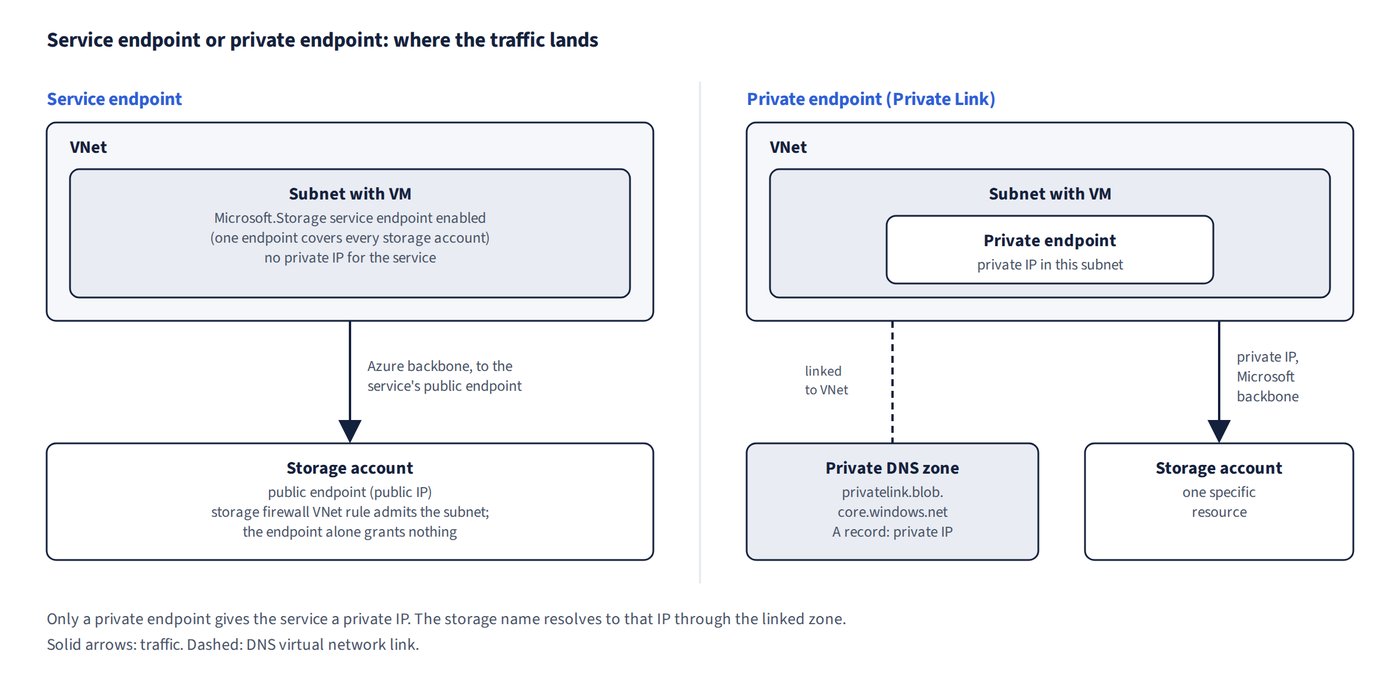
A private endpoint (Azure Private Link) gives a PaaS resource such as a storage account a private IP in your VNet, so VM traffic to it stays on the Microsoft backbone. It is the only option that gives a private IP.
Private endpoints give access to specific PaaS resources; they don’t connect networks.
Azure Peering Service optimises routing between an ISP and Microsoft; it has nothing to do with private PaaS access.
| Option | Private IP in your VNet? | Scope |
|---|---|---|
| Service endpoint | No (public endpoint over the Azure backbone) | Whole service type from a subnet (for example all storage accounts) |
| Service endpoint policy | No | Limits a Microsoft.Storage endpoint to listed storage accounts |
| Private endpoint | Yes | One specific PaaS resource |
Clients find the private IP through DNS: the private endpoint’s A record is kept in a private DNS zone such as privatelink.blob.core.windows.net (for Blob storage), and that zone must be linked to the VNet so that the storage account’s usual name resolves to the private IP. (See Figure 12.2.)
This note is one section of Ultra Transcenders AZ-104: Microsoft Azure Administrator, an independent study guide that explains every topic the exam covers by technology, with comparison tables, diagrams and the common traps, plus a glossary linked to Microsoft Learn.
About the book · Free AZ-104 glossary · All AZ-104 study notes
Where LRS, ZRS, GRS, RA-GRS, GZRS and RA-GZRS keep your copies, what each survives, and which account types support them.
The three SAS types, what each can grant, how they're signed, and how to revoke one when a token leaks.
How the storage account firewall decides who gets in: IP rules, VNet rules with service endpoints, private endpoints and the trusted-services exception.
The order Azure applies subnet and NIC network security groups for inbound and outbound traffic, how priority works, and a worked example.
Which App Service tiers allow manual scale-out, autoscale, slots and how many instances, and the difference between scaling up and scaling out.
Fault and update domains, zones, the SLA each gives, and what you can and can't change after a VM is created.
What delete and read-only locks block, how they inherit, and the surprising things a ReadOnly lock stops (like listing storage keys).